How much does SEO cost in the UK?
The honest answer from an agency that sells it: anywhere from £300 to £10,000+ a month, and the difference is not quality. It is scope, competition, and how much of the fee actually turns into work. Here is how to read a quote.
Quick answer: in 2026, UK SEO typically costs £300–£1,000 a month with a freelancer, £750–£2,000 a month with a boutique agency, and £3,000–£10,000+ with a larger agency. A one-off technical audit runs £1,500–£5,000. Anything under £300 a month is usually reporting theatre.
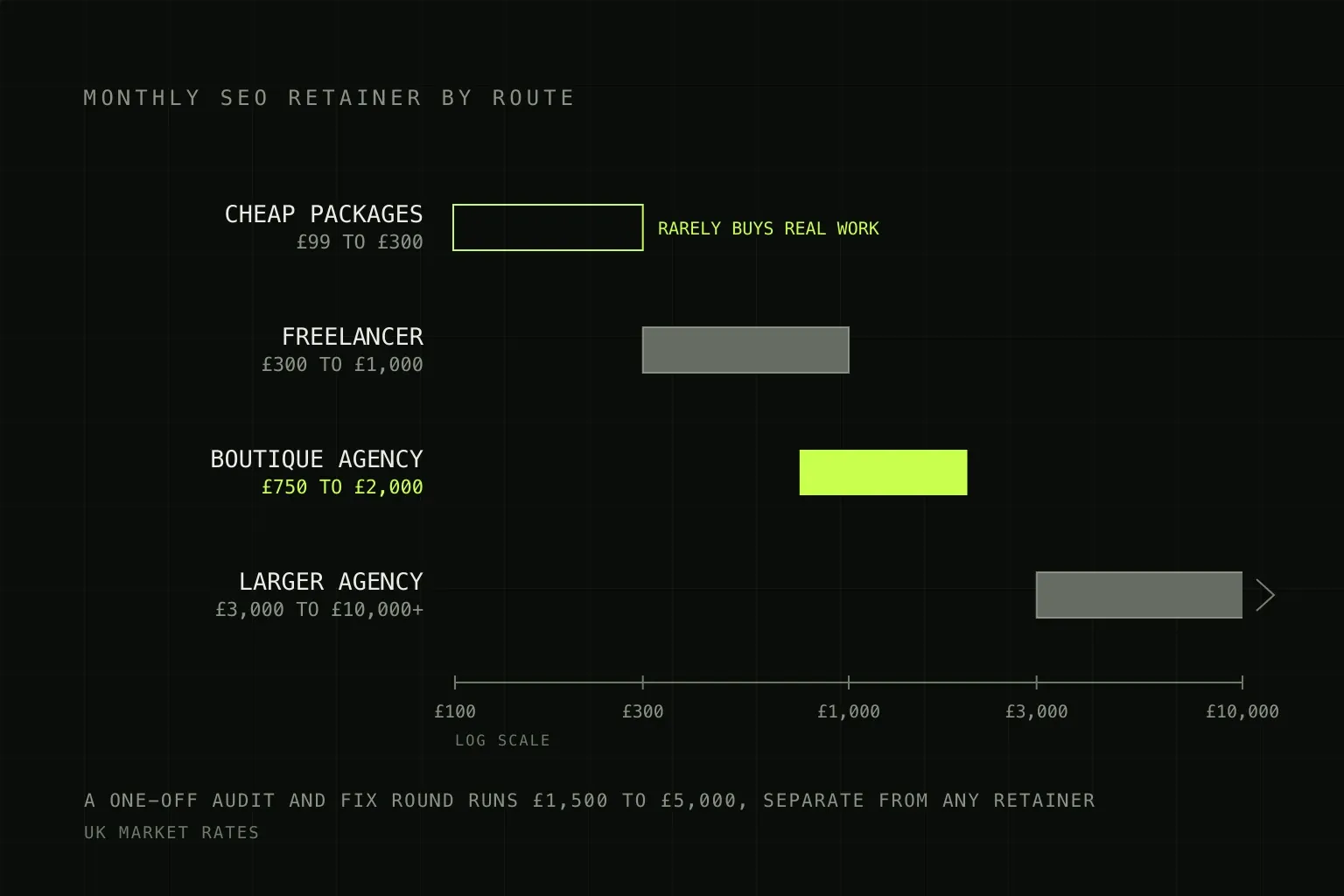
The bottom band is on the chart because it is sold, not because it works.
UK SEO pricing bands in 2026
SEO quotes for the same business can differ by 10x, and unlike a website build, you cannot see what you bought at launch. That makes understanding the bands more important, not less:
| Route | Typical UK price | What you actually get |
|---|---|---|
| Cheap packages | £99–£300/month | Automated audits, thin AI-spun blog posts, directory links. At best nothing happens. At worst you pay again later to clean up the links. |
| Freelancer | £300–£1,000/month (£250–£500/day) | A capable individual doing real work part-time on your site. Good for local SEO and focused fixes. Capacity is the limit: one person cannot write, build links and fix code at once. |
| Boutique agency | £750–£2,000/month | A proper roadmap, technical fixes, content production and reporting you can verify. The sweet spot for most SMEs and startups in competitive but winnable markets. |
| Larger agency | £3,000–£10,000+/month | Teams, tooling and scale for national brands and hard commercial keywords. Overkill for most local and niche businesses. |
| One-off audit + fixes | £1,500–£5,000 | A full technical and content audit with a prioritised fix list, implemented or handed to your team. The right choice when the problem is specific rather than ongoing. |
How much does SEO cost per month in the UK?
Most UK SEO is sold as a monthly retainer rather than a project, so the more useful question is what a month actually contains. For a boutique agency retainer of £750–£2,000 a month, which is where most SMEs land, a typical month looks like this:
| Monthly retainer | What a month realistically contains |
|---|---|
| £300–£750 | Roughly 3 to 6 hours of real work. Enough to maintain a small local site: one or two content pieces, minor technical fixes, and a report. Not enough to move a competitive term. |
| £750–£1,500 | Roughly 8 to 15 hours. Two to four content pieces, ongoing technical work, internal linking, some outreach, and monthly reporting against actual rankings and traffic. |
| £1,500–£3,000 | Roughly 15 to 30 hours. A genuine content programme, technical roadmap delivery, digital PR or link acquisition, and conversion work on the pages that already rank. |
| £3,000+ | A team rather than a person. Justified when the keywords are nationally competitive and a single position is worth thousands a month. |
The useful test is to divide the retainer by a realistic UK hourly rate of £60 to £100 and ask whether the deliverables could plausibly fit in those hours. A £400-a-month package promising "unlimited content and 50 backlinks" fails that test immediately, and the arithmetic is the fastest way to spot it.
On timing, be sceptical of anyone promising month-one results. Technical fixes can show within weeks, but content and authority work typically takes 3 to 6 months to move meaningfully, and competitive terms can take a year. That is why most agencies ask for a minimum three to six month commitment, and why judging SEO on a single month of data tells you almost nothing.
What actually drives the price
Four factors explain almost every quote you will receive:
- Competition. Ranking a plumber in Stirling and ranking a national insurance comparison site are different sports. The stronger the sites above you, the more content and authority it takes to pass them.
- Technical state. A fast, well-structured site needs a tune-up. A decade of plugins, redirects and duplicate pages needs surgery, and that surgery is priced in.
- Content production. Rankings follow pages that deserve to rank. If your market needs 30 in-depth pages and you have 5, someone has to research and write the other 25.
- Authority building. Earning links and mentions from real sites is slow, manual work. It is also the part cheap packages fake with directories and link farms.
What each budget actually buys
A useful rule: after tools and reporting overhead, roughly 70 to 80 percent of a good retainer should turn into visible work. At £500 a month that is a day or so of expert time: enough for local SEO, steady technical improvements and a piece of content. At £1,500 a month you get a real programme: content production, authority building and technical work running in parallel. Below £300, after overhead there is almost nothing left, which is why those packages lean on automation. If a proposal cannot tell you what happens each month in plain English, the overhead is the product.
Red flags that cost you money
- Guaranteed rankings. Nobody controls Google. A guarantee means either a meaningless keyword nobody searches, or a refund policy priced into the fee.
- "We'll get you 100 backlinks a month." Volume promises mean link farms. Google's penalties for this are real and expensive to recover from.
- No access to your own data. You should own your Search Console, analytics and any content produced. Walking away should not mean starting over.
- Reports without work logs. A ranking chart is not an invoice. Ask any provider to list what they actually did last month; honest ones already do.
- 12-month lock-ins. Good agencies keep clients with results. Long contracts exist to keep clients without them.
The 2026 shift: SEO now includes AI search
A growing share of searches never reach a results page. ChatGPT, Gemini and Google's AI Overviews answer directly and cite a handful of sources, so being the cited source now matters as much as ranking. This is called AEO (answer engine optimisation): structuring content so AI engines can quote it, marking pages up with the schema they parse, and publishing the kind of specific, factual content they cite. When you compare quotes, ask how AI search is handled. At ZevGeeks it is part of the SEO work, not a separate line item, because it is the same discipline applied to a new results page.
How to keep the cost down (without wrecking the outcome)
- Fix the technical debt once. A one-off audit and fix project often beats months of retainer spent working around a broken site.
- Write what your buyers ask. One in-depth page answering a real buying question beats five generic posts. Cost guides like this one are the format that ranks and gets cited.
- Start where you can win. City and niche keywords convert better and cost less to rank for than national head terms. Earn the hard ones later.
- Keep ownership of everything. Your domain, your Search Console, your content. It makes providers replaceable, which keeps them honest.
Related guides: before you commit to a retainer, why is my website not ranking shows you how to check whether your pages are even indexed, which changes what you should be buying. AI search optimisation covers what is worth doing to be cited by ChatGPT, Claude and AI Overviews, and what is being oversold. Budgeting for a new site as well? See our UK website cost guide.
Frequently asked questions
What does SEO typically cost per month in the UK?
Most UK small and mid-sized businesses pay between £750 and £2,000 a month for a boutique agency retainer. Freelancers typically charge £300 to £1,000 a month, and larger agencies £3,000 to £10,000 or more. One-off technical audits usually run £1,500 to £5,000 depending on site size.
Why do SEO prices vary so much?
Because the work varies. Ranking a local trades business in one city is a different job from ranking a national ecommerce store against established competitors. Competition level, the technical state of your site, how much content needs producing, and whether link building is required drive most of the difference.
Is cheap SEO (under £300 a month) worth it?
Almost never. At that price there is no budget for real work after reporting overhead, so you tend to get automated audits, thin blog posts and directory submissions. At best it does nothing; at worst, spammy links earn penalties that cost more to clean up than good SEO would have cost in the first place.
Should we pay for a one-off project or a monthly retainer?
Both are legitimate. A one-off audit plus implementation suits sites with specific technical problems or teams who can execute in-house. A retainer suits competitive markets where content, authority and rankings need continuous work. Be wary of retainers that cannot explain what happens each month.
What does SEO with ZevGeeks include?
A prioritised roadmap based on a real audit, technical fixes, content mapped to buyer intent, and transparent monthly reporting on the work done. AEO (visibility in ChatGPT, Gemini and Google's AI Overviews) is included, not sold as a separate add-on. No guaranteed rankings, because nobody honest guarantees Google.