How much does a Shopify store cost in the UK?
Somewhere between £150 and £40,000+, and almost all of that range comes down to catalogue complexity and how custom the build needs to be, not the platform itself. Here's how to work out what your store should cost.
Quick answer: in 2026, a professionally built Shopify store in the UK typically costs £3,000–£10,000 from a boutique agency, £1,500–£4,000 from a freelancer, and £15,000–£40,000+ for a Shopify Plus build with a larger studio. That's the build cost. Shopify's own plan fee is separate and starts at under £25 a month.
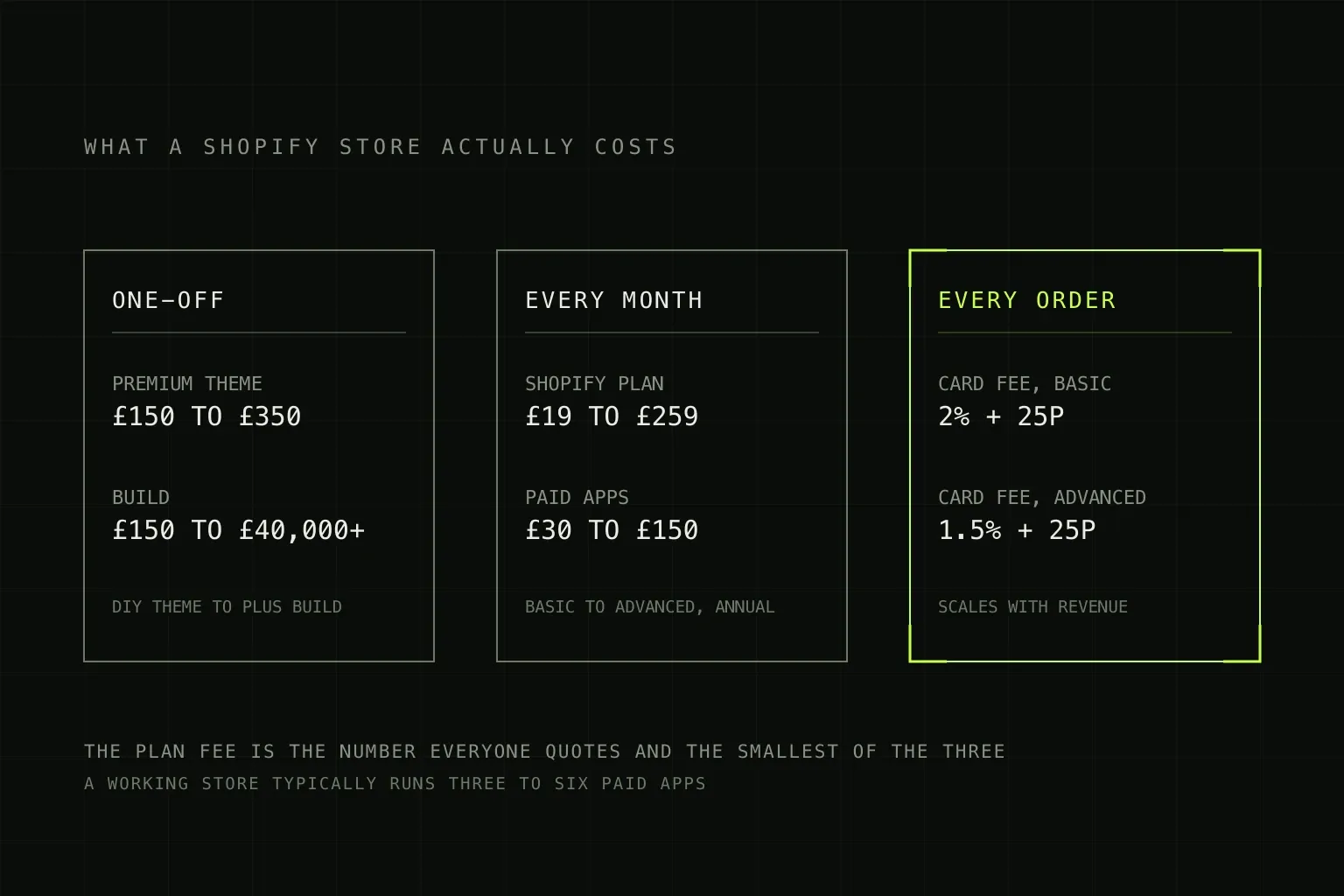
Three different clocks. A build quote usually only covers the first one.
UK Shopify build costs in 2026
Like any "build me a website" quote, the number depends entirely on scope. Here's the realistic landscape for a Shopify store specifically:
| Route | Typical UK price | What you actually get |
|---|---|---|
| DIY with a theme | £150–£500 + your time | A premium Shopify theme customised by you. Fine for a first store with a small, simple catalogue. |
| Freelancer | £1,500–£4,000 | A capable individual setting up theme customisation, basic apps, and product data. Quality and reliability vary widely at this tier. |
| Boutique agency | £3,000–£10,000 | Custom or heavily customised theme, proper collection and metafield structure, checkout and app configuration, and accountability for launch. The right tier for most D2C brands and SMEs. |
| Shopify Plus / larger agency | £15,000–£40,000+ | Custom checkout, multi-storefront or B2B logic, ERP and inventory integrations, migration from a legacy platform. Right for high-volume or complex catalogues. |
What actually drives the price
Five factors explain almost every Shopify quote you'll receive:
- Catalogue size and structure. Twenty products in three collections is a very different job from two thousand SKUs across variants, sizes, and bundles.
- Custom vs template theme. A configured premium theme is fast and affordable. A bespoke design needs real design and development hours, but it's often what separates a store that converts from one that doesn't.
- Apps and integrations. Reviews, subscriptions, loyalty, email marketing, ERP or accounting sync: each is a small piece of work, and they add up fast in both cost and ongoing complexity.
- B2B and multi-channel needs. Wholesale pricing tiers, trade accounts, and syncing stock across Shopify, Amazon, and Etsy all add real scope beyond a standard retail storefront. Those marketplaces also carry account risk your own store does not, which is what our marketplace seller support hub covers: suspensions, appeals, and payout holds on eBay, Amazon, Etsy, and Walmart.
- Migration. Moving from WooCommerce, Magento, or a legacy platform means product data, customer accounts, order history, and redirects all need to survive the move without losing your search rankings.
Shopify's own monthly fees in the UK (2026)
The build cost above is separate from what Shopify itself charges you every month. Shopify prices its UK plans in pounds, so there's no currency risk to worry about. Here are the current UK figures:
| Plan | Billed annually | Billed monthly | Online card rate | Third-party gateway fee |
|---|---|---|---|---|
| Basic | £19/month | £25/month | 2% + 25p | 2% |
| Grow | £49/month | £65/month | 1.7% + 25p | 1% |
| Advanced | £259/month | £344/month | 1.5% + 25p | 0.6% |
| Plus | From £1,800/month | From £1,800/month | Negotiated | 0.2% |
Most new UK stores start on Basic and move to Grow once order volume justifies the lower card rate. Paying annually rather than monthly saves roughly 25% on every plan.
The fee people miss is the third-party gateway fee in the last column. If you process payments through Shopify Payments, you pay nothing extra. If you use an outside processor such as PayPal or Stripe as your main gateway, Shopify charges that percentage on top of whatever your processor charges. On Basic that is 2% of every order, which on £10,000 of monthly revenue is £200 a month for nothing. Check this before you commit to a gateway.
One more thing worth budgeting for: paid apps. Reviews, subscriptions, loyalty and advanced email tools are typically £10 to £50 a month each, and a working store often runs three to six of them. Realistically, add £30 to £150 a month on top of your plan fee.
Fixed price vs hourly: insist on fixed
The same logic applies here as with any web project: hourly billing puts the risk on you, and a fixed price agreed against a written scope puts it on the provider. It also forces the one conversation that actually matters upfront: what exactly are we selling, and how many SKUs, variants, and channels does the store need to handle? If an agency can't give you a fixed number once they know that, they haven't scoped it properly yet.
You can see what a properly scoped ecommerce build produces in our work, including multi-region B2B and retail platforms, or read more about our ecommerce service.
How to keep the cost down (without wrecking the outcome)
- Launch with your core catalogue, not everything. A focused first release with strong collection structure beats a bloated one. You can add lines after launch.
- Have product data ready. Photography, descriptions, and pricing decided before build starts is the single biggest schedule-saver.
- Be deliberate with apps. Every app is a recurring cost and a potential speed hit. Start with what you need on day one, not what might be useful someday.
- Use a strong theme as your base. Bespoke-from-scratch is rarely necessary. Heavy customisation of a solid theme gets most brands 90% of the way for a fraction of the cost.
- Don't skip migration planning. The cheapest quote that ignores redirects and order history is the most expensive one a year later.
Related guides: still deciding on a platform? Read Shopify vs WooCommerce for UK stores. For the full picture across every type of website, see our UK website cost guide. Once the store is live, ecommerce automation covers what to automate first, starting with the tools Shopify already gives you free.
Frequently asked questions
What does a typical small business Shopify store cost in the UK?
For a professionally designed store with a handful of collections from a boutique agency, expect £3,000 to £8,000. Freelancers may quote less; a Shopify Plus build for a larger catalogue costs considerably more.
Do I need Shopify Plus?
Only if you need enterprise features: high order volume, complex B2B pricing, multiple storefronts on one back end, or deep custom checkout logic. Most stores launch on Basic or Grow and only move to Plus once volume genuinely demands it.
What are Shopify's own monthly fees in the UK?
Billed annually, Basic is £19 a month, Grow £49, Advanced £259 and Plus from about £1,800. Billed monthly those become £25, £65 and £344. Shopify prices UK plans in pounds, so there is no currency risk, and paying annually saves roughly 25%.
What transaction fees does Shopify charge in the UK?
If you use Shopify Payments you pay card processing only: 2% + 25p on Basic, 1.7% + 25p on Grow and 1.5% + 25p on Advanced. If you use an outside gateway such as PayPal or Stripe as your main processor, Shopify adds a further fee on top: 2% on Basic, 1% on Grow, 0.6% on Advanced and 0.2% on Plus. That extra fee is the cost most merchants overlook.
Is a template cheaper than a custom design in the long run?
Upfront, yes: a premium theme is £150–£350 one-off. But templates get generic fast and rarely fit an unusual product range or checkout flow. A custom or heavily customised theme costs more once, but converts better and doesn't need reworking within a year.
Can you migrate an existing store to Shopify?
Yes. Product data, customer records, order history, and URL redirects all need to move carefully to protect your search rankings and avoid losing historical order data. This is a standard part of what we quote for, so ask for it explicitly if you're moving off WooCommerce, BigCommerce, or another platform.