How much does AI automation cost in the UK?
The honest answer: the software is nearly free. It's the thinking that costs money. A single workflow can be £500; an enterprise programme £50,000. Here's how to know what your situation should cost, and whether it pays back.
Quick answer: in 2026, a single automated workflow from a UK freelancer typically costs £500–£1,500. A boutique agency project, meaning an audit plus several connected workflows with error handling and documentation, runs £1,500–£6,000. Enterprise consultancies start around £15,000. The platform itself (Make.com) is roughly £8–£30+ per month.
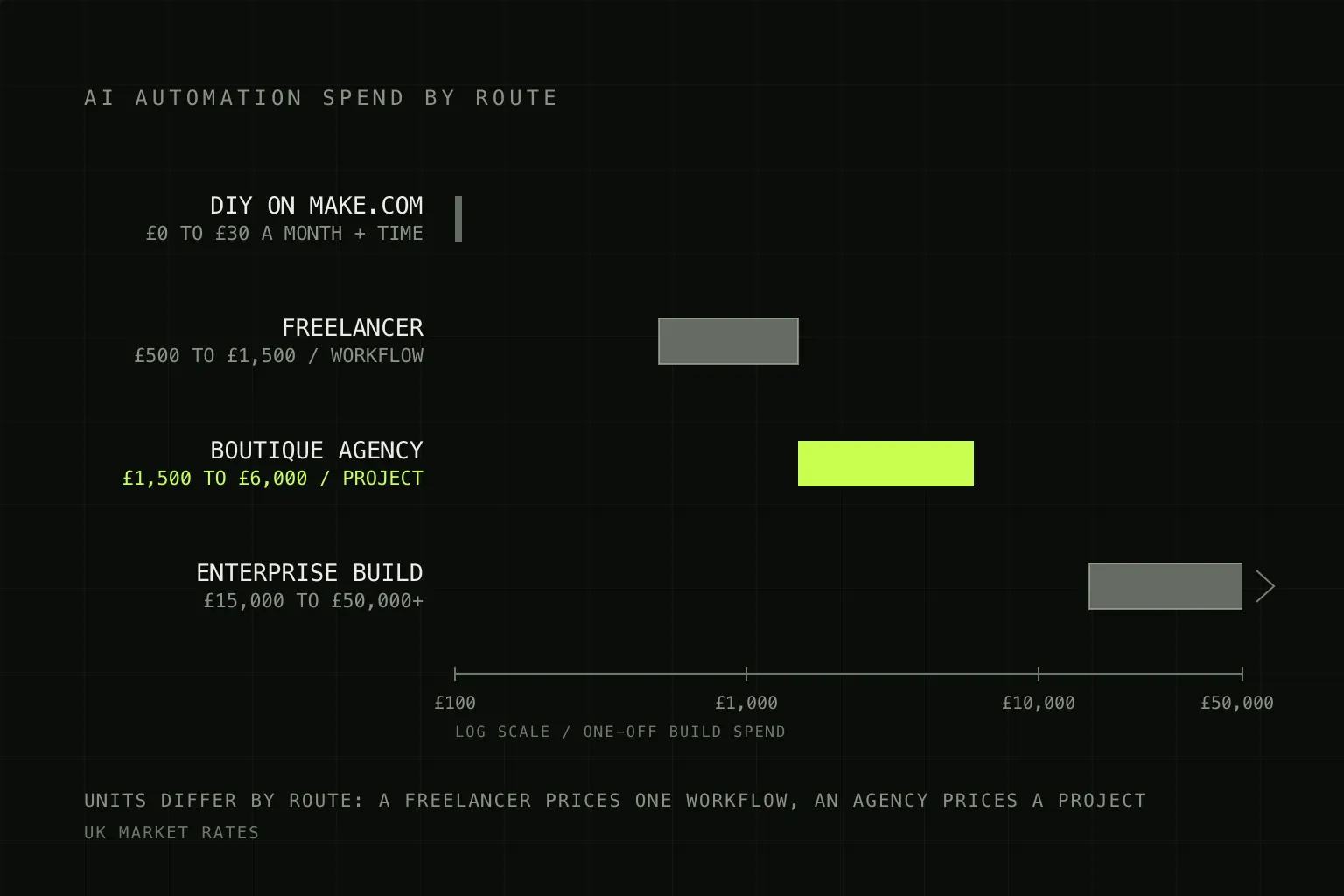
The same job, priced four ways. Note that the unit changes as you move up.
UK automation pricing bands in 2026
"AI automation" covers everything from a two-app trigger to a custom LLM application, which is why quotes vary so wildly. Here's the realistic landscape:
| Route | Typical UK price | What you actually get |
|---|---|---|
| DIY on Make.com | £0–£30/month + your time | Make has a free tier and excellent templates. Fine for simple two-app connections; without error handling, DIY scenarios tend to break silently the first time an API hiccups. |
| Freelancer / consultant | £500–£1,500 per workflow | Day rates of £300–£500 are the norm. Good for one well-defined problem; you own the maintenance when they move on, so insist on documentation. |
| Boutique agency | £1,500–£6,000 per project | An audit of what's worth automating, several connected workflows, error handling and monitoring, documentation, and accountability. The sweet spot for most SMEs. |
| Enterprise consultancy / custom AI build | £15,000–£50,000+ | Custom LLM applications, RPA programmes, compliance reviews, change management. Right when the process being automated carries regulatory or revenue-critical weight. |
What actually drives the price
Six factors explain almost every automation quote you'll receive:
- Number of workflows. Automating lead capture is one job. Automating lead capture, CRM enrichment, invoicing, and reporting is four, even if they're sold as one "project".
- The systems being connected. Tools with clean, documented APIs (Shopify, Slack, Airtable, most CRMs) are quick. Legacy software, scraping, and anything without an API multiplies the hours.
- Data messiness. If your product names, customer records, or spreadsheets are inconsistent, someone has to handle every edge case. Clean data is the biggest cost-saver you control.
- AI steps. Adding a model to qualify leads or draft replies means prompt design, testing against real examples, and deciding what happens when the model is unsure. It's worth it, but it isn't free.
- Error handling and monitoring. The difference between a demo and a system you can trust. Cheap quotes usually skip this, and you find out three weeks later when orders quietly stopped syncing.
- Documentation and handover. Plain-English docs mean your team understands what runs where. Without them, you're renting your own business process back from whoever built it.
Ongoing costs: what you pay after the build
The platform is the small line item: Make.com plans suitable for most SMEs run roughly £8–£30+ per month depending on volume, paid directly to Make. AI usage, meaning the steps that call a model, is billed per use and typically comes to £5–£50 a month at small-business volume. Optional support retainers in the UK run £150–£750 a month, and are worth it when processes change often; a well-built, well-documented workflow otherwise runs unattended for months.
The maths that matters: will it pay back?
Price only means something against what the busywork costs you now. The honest calculation is short: hours saved per week × loaded hourly cost × 52. Someone spending six hours a week re-typing orders, chasing stock levels, and copying leads into a CRM at £25 an hour is a £7,800-a-year problem, against a one-off build in the low thousands. If the numbers don't clear that bar, don't automate it; a good agency will tell you that on the first call.
Fixed price vs day rate: insist on fixed
Day-rate billing puts all the risk on you: the less efficient the builder, the more you pay, and automation work is notorious for "one more edge case" overruns. A fixed price against a written scope flips that risk onto the provider and forces the useful conversation upfront: which processes, connecting which systems, handling which failures? If someone can't give you a fixed number, they haven't understood your process yet.
That's how we work at ZevGeeks: audit first, scope in writing, fixed price, plain-English documentation at handover. See our AI automation service, the ecommerce-specific version, or our work.
How to keep the cost down (without wrecking the outcome)
- Automate one painful process first. Prove the payback on the worst offender, then expand. Big-bang automation projects stall.
- Clean your data before the build starts. Consistent naming and deduped records can cut the quote meaningfully.
- Stay on mainstream tools. If you're choosing software anyway, pick tools with good APIs. The automation cost difference is real.
- Don't skip error handling to save money. It's the cheapest line in the quote and the most expensive one to omit.
- Ask what shouldn't be automated. The right answer to some processes is a better form, not a robot. An honest provider will say so.
Related guides: new to the topic? Start with what AI automation actually is. Choosing a platform? See our Make.com vs Zapier comparison, n8n vs Make, or the full field in the best Zapier alternatives. Choosing who builds it? See how to hire an AI automation expert. Running a store? Ecommerce automation covers what to automate first in Shopify, including the parts that cost nothing.
Frequently asked questions
What does a typical first automation project cost in the UK?
A single well-built workflow from a UK freelancer typically costs £500 to £1,500. A boutique agency project covering an audit and several connected workflows usually lands between £1,500 and £6,000. Enterprise consultancy engagements start around £15,000 and climb quickly.
What does the automation software itself cost?
Very little compared with the build. Make.com plans suitable for most small businesses run roughly £8 to £30+ per month depending on how many operations you use, paid directly to Make. The build quality determines whether you burn operations on errors or run lean.
Do AI API costs add much on top?
Rarely at SME volume. Steps that call a model, such as summarising enquiries, qualifying leads or drafting replies, are billed per use by the AI provider, and for most small businesses that comes to somewhere between £5 and £50 a month. Costs only get interesting at very high volumes, which is a nice problem to have.
Is automation a one-off build or an ongoing retainer?
It can be either. A well-documented workflow with proper error handling runs unattended for months, so a one-off build is legitimate. Retainers, typically £150 to £750 a month in the UK, make sense when your processes change often or you want someone watching the error logs and iterating. Be wary of anyone who insists a simple workflow needs a large mandatory retainer.
What does a fixed price from ZevGeeks include?
An audit of what's worth automating, the Make.com scenario builds, error handling and monitoring, plain-English documentation, and handover. Scope and price are agreed in writing before work starts, and we'll tell you honestly if a process isn't worth automating.