Do you need a LinkedIn ghostwriter?
Ghostwriting can turn your profile into an inbound channel, or it can be money spent sounding like everyone else's feed. This guide is the honest test: what a ghostwriter actually does, who genuinely benefits, who shouldn't bother, and how to pick one that still sounds like you.
Quick answer:you need a LinkedIn ghostwriter if your buyers are on LinkedIn, you have real expertise worth sharing, and you keep failing to find the three to five hours a week that consistent posting takes. If you enjoy writing and have the time, or your customers aren't on LinkedIn, you don't.
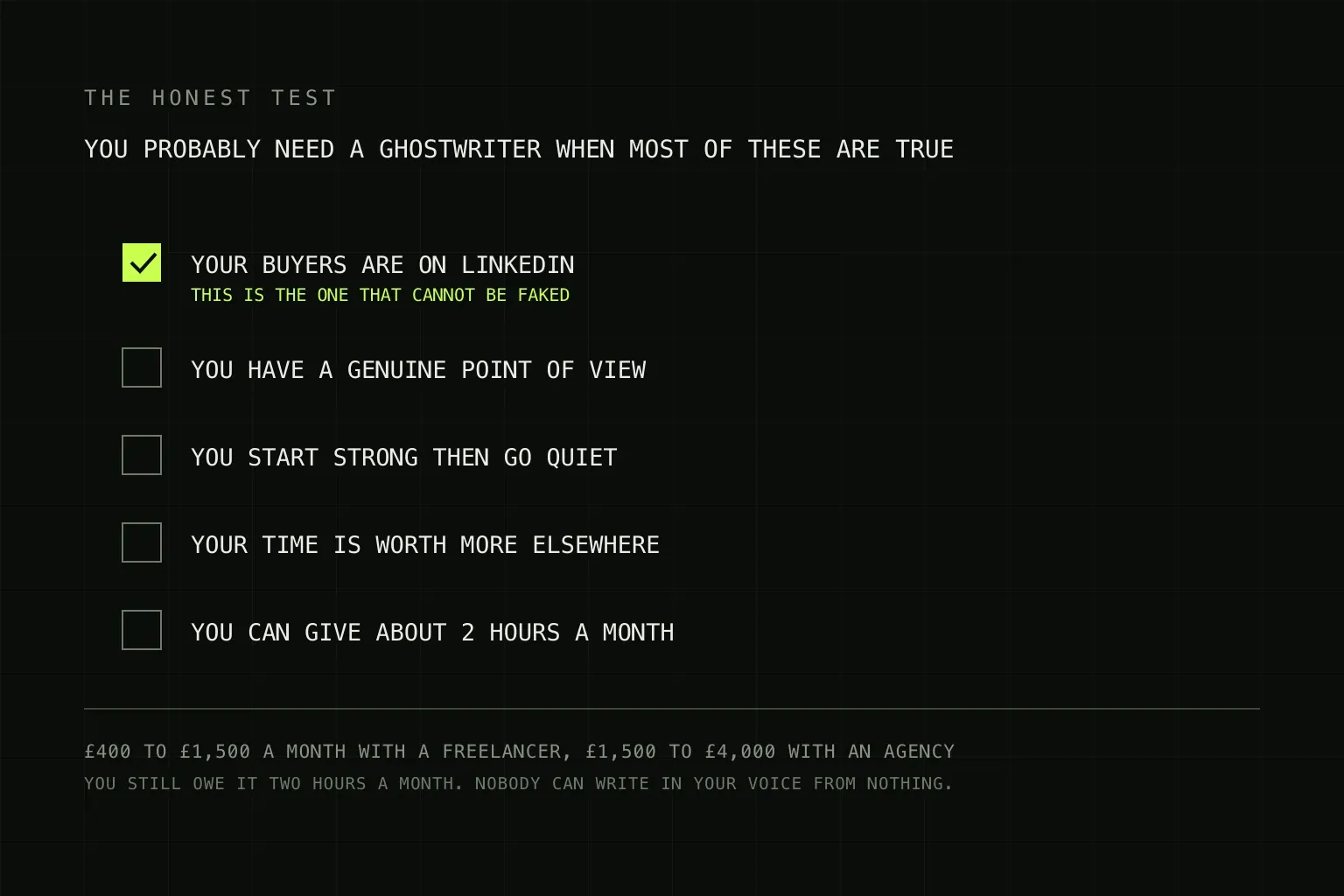
Most of these should be true. The first one has to be.
What does a LinkedIn ghostwriter actually do?
A LinkedIn ghostwriter writes posts that go out under your name, in your voice, so you build a personal audience without sitting down to write every week. At the cheap end that means someone tidying up notes you send them. Done properly, it is a small operation: deciding what you should be known for, interviewing you to capture your real stories and opinions, writing in a way that sounds like you, and keeping the posts flowing on a schedule you would never hold to alone.
It is worth separating from two things it gets confused with. A copywriter writes one-off assets like a landing page; a ghostwriter builds an ongoing body of personal content. A social media manager runs your company's channels across platforms; a ghostwriter writes as one person, usually the founder, because on LinkedIn personal profiles consistently out-reach company pages. If the goal is your authority rather than your logo's, ghostwriting is the job.
The honest test: do you actually need one?
You probably need a ghostwriter when most of these are true:
- Your buyers are on LinkedIn. For B2B services, SaaS, consulting and recruiting, they usually are. This is the one that can't be faked.
- You have a genuine point of view. Strong opinions, hard-won lessons, client stories, data nobody else has. There has to be something to write from.
- You start strong then go quiet. If you post enthusiastically for three weeks then vanish for three months, you have a consistency problem, and consistency is exactly what a ghostwriter sells.
- Your time is worth more elsewhere. If an hour of yours is better spent running the business than drafting posts, the maths usually favours delegating.
- You can give ~2 hours a month. Interviews and approvals still need you. Nobody can write in your voice from nothing.
If you can't tick the first two, no ghostwriter will help; the problem is audience or material, not writing. If you can tick the first two but not the rest, you might just need to block time in your own calendar before spending anything.
Signs you'd benefit, and signs you wouldn't
| A ghostwriter is worth it | Skip it (for now) | |
|---|---|---|
| Your buyers | Are active on LinkedIn | Come via referral, search or offline |
| Your time | Is scarce and expensive | Is plentiful, and you enjoy writing |
| Your consistency | Starts strong, then fizzles | You already post reliably |
| Your material | Rich: opinions, client stories, data | Thin, or you can't share client work |
| Your horizon | Can sustain six months or more | Only wants a one-off burst |
The pattern is simple: a ghostwriter is worth it when the audience and material are there but the time and consistency aren't. That is the exact gap the service fills.
What a ghostwriter can't do for you
The honest limits, because knowing them is how you avoid wasting money:
- They can't invent expertise you don't have. Give a writer nothing real to work from and the posts read hollow, however polished.
- They can't move your buyers to LinkedIn. If your customers aren't there, the wrong audience beats good writing every time.
- They can't skip your input. The best posts come from you talking. Providers who don't interview you produce the generic stuff everyone scrolls past.
- They can't promise virality or a fixed timeline. Reach and engagement usually grow within a month or two of consistent posting, and meaningful inbound follows in months two to four. Anyone guaranteeing week-one results is guessing.
Ghostwriter, agency, or do it yourself?
If you've decided the channel is worth it, there are three honest routes:
- Do it yourself. Cheapest and the most authentic voice possible, if you actually keep it up. Most founders don't, and inconsistency is what kills LinkedIn reach.
- A freelance ghostwriter. Buys you the writing, but you still steer strategy, and quality varies enormously. The good ones interview you properly; the cheap ones paraphrase your bullet points.
- A boutique agency. Strategy, monthly interviews, consistent posting and reporting handled for you. The right fit for founders who want a real presence without running it themselves.
The right route is about being honest with yourself about time and consistency, not just budget. For real UK numbers on each option, and how to work out whether it pays back, see our LinkedIn ghostwriter cost guide.
How to choose one that still sounds like you
Whichever route you pick, these are the questions that separate a real service from a template mill:
- How do you capture my voice? If the answer isn't a recorded interview, expect posts that sound like everyone's feed.
- Can I see samples for other clients? Good sign: those clients sound distinct from each other. Bad sign: they all sound the same.
- Who actually writes? Paying premium prices for junior output is the most common trap in this market.
- What's the fixed monthly price and scope? How many posts, is strategy included, what happens to unused posts. If they can't give a straight number, they haven't decided what they're selling.
- What's the commitment? Three months is enough to judge whether it's working. Be wary of anyone who needs a twelve-month lock-in to show results.
That is how we work at ZevGeeks: a recorded interview every month, posts written in your voice, everything approved by you before it goes live, at a fixed monthly price agreed upfront. See our LinkedIn personal branding service for what's included, or browse every guide.
Frequently asked questions
Do I need a ghostwriter, or can I just use ChatGPT?
ChatGPT can draft a post, but it can't decide what you should be known for, capture your real stories, or keep you posting every week once work gets busy. Generic AI output is exactly what LinkedIn feeds are drowning in, and readers scroll past it. A ghostwriter buys the judgement and the consistency, not the typing.
What's the difference between a LinkedIn ghostwriter and a social media manager?
A social media manager usually runs your company's channels: scheduling, graphics and replies across platforms. A LinkedIn ghostwriter writes in the voice of one person, usually a founder or executive, to build their personal authority. Personal profiles out-reach company pages on LinkedIn, so the two jobs are different and often run in parallel.
Will people know my posts are ghostwritten?
Not if it's done properly. Good ghostwriting starts from recorded interviews with you, so the ideas, opinions and stories are genuinely yours and the writer only shapes them. It reads as ghostwritten only when a provider skips the interview and writes generic posts anyone could have published.
How many posts a week do I actually need?
Two to three consistent posts a week is plenty to build authority; consistency matters far more than volume. Most founders are better off sustaining two good posts a week for a year than five a week for a month before burning out. Start low, prove the channel works, then scale.
Is a ghostwriter worth it for a solo founder or small business?
It depends entirely on where your buyers are. For B2B services, SaaS and consulting, LinkedIn is usually where they look before they buy, and a ghostwriter pays back by freeing founder hours. If your customers aren't on LinkedIn, no ghostwriter is worth it, and an honest one will tell you so.