Is Webflow good for SaaS?
The distinction that answers the whole question: marketing site, not product. Here's where Webflow genuinely excels for SaaS companies, where it doesn't fit, and what it costs.
Quick answer: yes. Webflow is the leading choice for SaaS marketing sites in 2026: fast to iterate, no plugin maintenance, strong Core Web Vitals, and marketers can ship pages without engineering time. It is not suitable for building the SaaS product itself; it handles the marketing site, blog and landing pages.
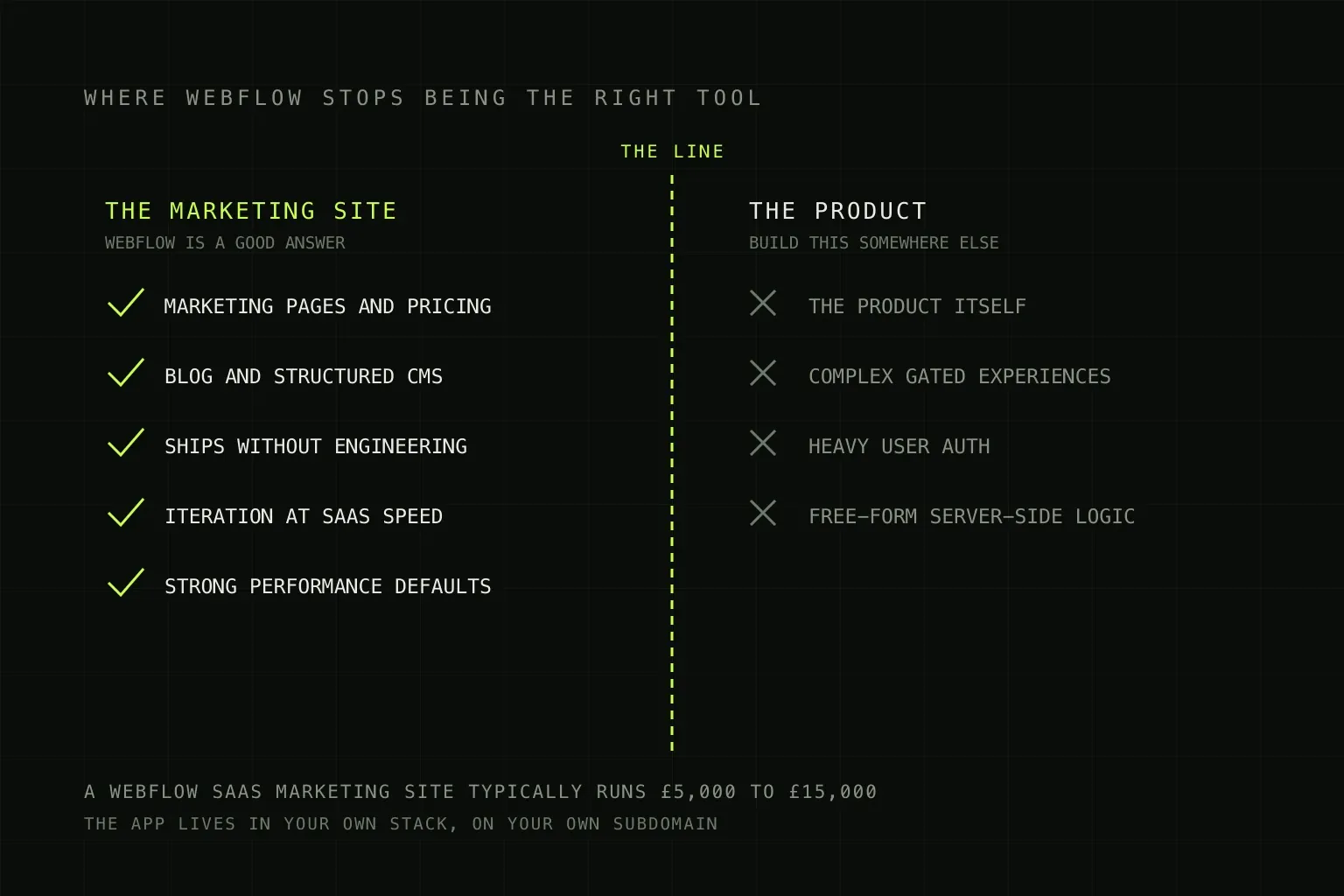
Webflow is excellent on one side of this line and the wrong tool on the other.
The full answer
Every SaaS company runs two codebases in practice: the product (your app, built by engineers) and the marketing site (the public site that sells it). Webflow is a contender for the second only, and for that job it has become the industry default.
The reason is organisational, not technical. On a custom-coded marketing site, every pricing tweak, landing page and case study goes through engineering. Engineers hate the interruptions, marketing hates the queue, and pages that should take a day take a sprint. Webflow removes the queue: marketing designs, builds and ships production-quality pages themselves, and engineering never hears about it. For an early-stage or scaling SaaS, that autonomy is worth more than any individual feature.
Why SaaS companies choose Webflow
- Marketing ships without engineering. The whole argument in one line. Campaign pages, pricing changes and new case studies go live the day they are ready.
- Iteration speed matches SaaS reality. Positioning changes, features launch, pricing evolves. A site you can change weekly without risk is a competitive asset.
- The design ceiling matches the SaaS bar. B2B buyers judge your product by your website. Webflow supports the animation, interaction and polish modern SaaS branding demands.
- Performance is strong by default. CDN hosting, clean code and automatic image optimisation give reliably good Core Web Vitals, for both paid landing pages and organic rankings.
- In good company. Teams at Dropbox, Discord, Upwork and Getty Images run marketing properties on Webflow. It is a proven pattern, not a bet.
What Webflow handles well for SaaS
The marketing site itself (home, features, pricing, customers), the blog and content marketing (the CMS comfortably runs structured content types, with 20,000 items on the current Premium plan), campaign landing pages spun up per channel and retired without developer time, and the long tail every SaaS accumulates: careers, changelog, legal. Light help content works; full product documentation is better served by a dedicated docs tool.
What Webflow can't do
- The product itself. Your app (accounts, dashboards, billing logic) is custom code. Webflow was never in contention for this.
- Complex gated experiences. Customer portals and content behind sophisticated access rules go beyond what Webflow's native tools do well.
- Heavy user auth. Webflow has basic membership features, but real user systems belong in your product stack.
- Free-form server-side logic. No arbitrary backend code on Webflow's servers; dynamic behaviour comes from integrations and APIs, which covers most marketing-site needs but not all.
Practical rule: if a page's job is to persuade, it belongs in Webflow. If its job is to function after login, it belongs in your product.
Webflow vs alternatives for a SaaS marketing site
| Webflow | WordPress | Framer | Custom (Next.js) | |
|---|---|---|---|---|
| Marketing autonomy | Full | Partial | Full | None; every change is a ticket |
| Maintenance burden | Near zero | Ongoing (plugins, patches) | Near zero | Your engineers |
| Design ceiling | High | Theme-dependent | High | Unlimited |
| Best when | Default choice | Content empire | Design-led, smaller sites | Site and product share code |
Full comparison with WordPress in our Webflow vs WordPress guide. Custom-coded marketing sites still make sense when the site and product genuinely share components and engineering capacity is not the constraint; for most SaaS teams, it is the most expensive way to get a slower marketing team.
How much does a Webflow SaaS site cost?
Platform costs are modest: Webflow's Premium site plan is $25/month billed annually (plans were restructured in May 2026; older articles cite defunct tiers). The real investment is design and build: for a SaaS marketing site done professionally, expect £5,000 to £15,000 depending on page count, custom interaction work and CMS complexity, with 4 to 8 weeks a typical timeline. Our fixed-price projects start from £2,500 (roughly $3,400); the full breakdown is in our Webflow cost guide. Against the alternative (engineering time spent on marketing pages, at engineer salaries, forever), the maths usually closes quickly.
Frequently asked questions
Do big SaaS companies use Webflow?
Yes. Teams at Dropbox, Discord, Upwork and Getty Images run marketing properties on Webflow, and it has become the default pattern for venture-backed SaaS: product in custom code, marketing site in Webflow.
Can you build an app in Webflow?
No, and it is the wrong question to judge Webflow on. Webflow builds websites, not applications with user accounts and business logic. SaaS companies use it for the marketing site while the product runs on their own stack.
Is Webflow better than WordPress for SaaS?
For the marketing site, usually yes: faster iteration, zero plugin maintenance, better performance defaults and marketing autonomy. WordPress still wins for massive editorial operations.
How much does a Webflow site cost for a SaaS startup?
Around £5,000 to £15,000 for professional design and build, plus roughly $25 a month in Webflow platform fees, billed in US dollars. Early-stage teams sometimes start from a quality template at lower cost and rebuild custom after funding. ZevGeeks projects start from £2,500 (roughly $3,400).
Can developers extend Webflow?
Yes. Custom code embeds, API integrations, and exported components let developers add what marketing cannot build natively. The day-to-day (pages, content, campaigns) stays in marketing's hands, which is the point.