How much does a logo and brand identity cost in the UK?
From nothing to fifty thousand pounds, and the more important question is what you actually own at the end. Here are the real UK numbers, the verified legal fees, and the ownership traps in the cheap routes.
Quick answer: in the UK in 2026, a logo alone typically costs £500–£3,000 from a professional designer, £249–£1,099 through a crowdsourcing platform, and £1,000–£3,500 from an agency. A full brand identity with strategy and guidelines runs £5,000–£20,000, and a complete rebrand with rollout £10,000–£50,000+. UK trade mark registration is a separate £205 plus £60 per extra class.
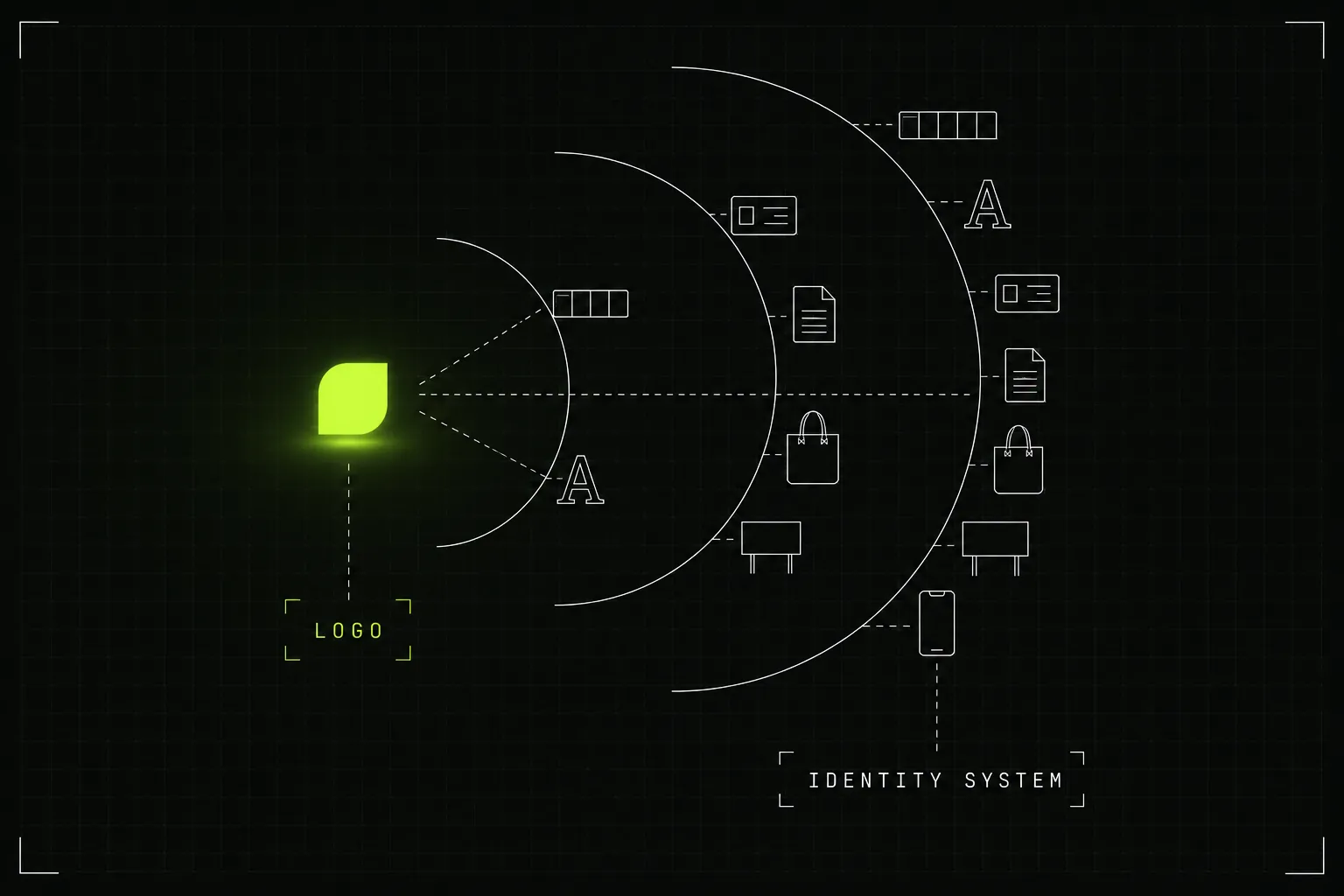
The logo is the centre. The cost lives in how far out the system has to reach.
A warning about every price you will read online
Before the numbers, something worth knowing that no other guide will tell you. There is no independent UK survey of what businesses actually pay for a logo or brand identity. Every price band you find, including the ones below, traces back to agency marketing content.
It is worse than it sounds. When we traced the sources, one widely cited "research" page turned out to cite seven other agency blogs, several of which cite each other. The apparent consensus is one circle of self-interested sources. We are quoting those bands below because they are the best available, but we are labelling them honestly, and where genuinely independent data exists we have used it instead.
UK price bands in 2026
| Route | Typical UK price | What you actually get |
|---|---|---|
| AI generators and DIY tools | £0–£50 | A logo file, often low resolution unless you upgrade. No strategy, no uniqueness, and serious ownership limits. See the section below before choosing this. |
| Crowdsourcing platforms | £249–£1,099 | One finished logo, full copyright transfer, up to three colour variations and an editable vector file. No guidelines, no typography system, no applications. |
| Freelance designer | £500–£1,000 typical | A brief, two or three directions, around two revision rounds, vector files and basic guidelines. Quality varies more than at any other tier. |
| Small studio or agency | £1,000–£3,500 | Proper discovery, considered options, a small guidelines document and full IP assignment. The sensible floor for a business that intends to grow. |
| Full brand identity system | £5,000–£20,000 | Strategy and positioning, complete visual system, a real guidelines document, and applied assets. What you buy when consistency across a team matters. |
| Complete rebrand with rollout | £10,000–£50,000+ | Everything above plus research, migration of every existing asset, and physical rollout. |
The crowdsourcing figures are the most reliable in that table because they are a published price list rather than an estimate. One major platform charges £249, £409, £739 and £1,099 across its tiers. Worth understanding what the extra money buys: more concepts, not more deliverables. The £1,099 tier gives you a larger pile of options and a better designer pool, but the same single logo and the same file set as the £249 tier.
What independent data actually says about rates
One genuinely neutral source exists: a UK freelancer platform that publishes rates from real bookings rather than from marketing pages. Its 2025 to 2026 figures put a branding designer at £396 a day, with design contractors averaging £385 and a typical contract running 15 working days.
Compare that with the agency blogs, which commonly claim UK freelance logo designers charge £500 to £900 a day. The transacted number is roughly half the top of that claim, and sits at the bottom of what those blogs call "mid-level". A separate survey of 403 illustrators in July 2026 found a UK median of £350 a day, with only 20% feeling fairly paid.
The practical use of this: at around £400 a day, a logo project involving three to four days of real work costs roughly £1,200 to £1,600 in designer time. That is the honest floor for considered professional work, and it explains why quotes below about £500 usually mean a template.
You cannot trademark a Canva logo
This is the single most useful thing in this guide, and most businesses discover it far too late.
Canva's Content License Agreement prohibits using its content "as part of a trade-mark, design-mark, trade-name, business name or service mark", fonts excepted. The licence it grants is explicitly non-exclusive. That is not a grey area or a risk to weigh, it is a contractual bar written into terms you agreed to. The only way to build a trademarkable logo in Canva is to use nothing but fonts, plain shapes and lines.
If you have built a business on a Canva logo and later want to protect the name and mark, that is a problem you will have to pay a designer to solve. It is worth checking now rather than at the point you are filing.
The picture for AI logo generators is similar but messier:
- Ownership depends entirely on the platform's terms, which differ enormously. On some tools, users on free plans do not own the output at all.
- Some platforms reserve the right to sublicense your image. On at least one major generator, paying users own their output but the platform can license it onward, which can put your logo in a competitor's hands.
- Elements are drawn from shared libraries, so the icon in your logo may appear in someone else's.
- UK solicitors have flagged a registration risk. Applications by users without underlying ownership can face refusal under section 5(4) of the Trade Marks Act 1994 and can fail the good-faith requirement.
- No AI platform accepts liability if its output happens to infringe an existing registered mark. They do not run clearance searches.
None of this means AI tools are useless. For a side project, an internal deck or testing a concept, they are fine. For a business whose name and mark are an asset you intend to defend, they are the wrong foundation.
UK trade mark fees, verified
These come from the Intellectual Property Office rather than any agency, so they are the firmest numbers in this guide. They also changed recently: IPO fees rose by an average of 25% on 1 April 2026, the first increase since 1998.
| Item | Fee |
|---|---|
| Online application, first class | £205 |
| Each additional class | £60 |
| Paper application, first class | £250 |
| Typical three-class application | £325 |
| Right Start, stage one then stage two | £125 + £125 |
| Renewal after ten years, first class | £245 (+£60 per extra class) |
Note that a design quote almost never includes this. If you see a guide quoting £50 for an additional class, it is out of date; the figure is £60.
The costs quotes leave out
Three recurring costs catch people out, and font licensing is the one almost nobody sees coming.
Fonts are licensed by use case, separately, and often annually. Desktop, web and app are three different purchases from most foundries. Web licences are typically priced by monthly pageview tier and valid for one year, which makes a typeface a recurringcost rather than a one-off. App licences are priced by monthly active users. A quality foundry's entry tier starts around $60 for a single style in a single use case, and a full family across desktop and web costs considerably more.
The trap is that a brand guidelines document specifying a commercial typeface commits you to a licence the design fee did not cover. Ask whoever designs your brand whether the fonts are open source, whether the licence is included, and what it costs to renew.
The others:
- Print-ready artwork setup: £75 to £250 when supplied files are not press-ready, and around £850 if a reproof is needed. Packaging artwork runs £550 to £1,500 per SKU.
- Illustration: UK illustrators run a median £350 a day, and roughly one in ten price by licence and usage rather than a flat fee, so bespoke brand illustration can carry ongoing usage terms.
- Stock imagery: a subscription from roughly £20 a month, more if you need video or large formats.
- Ongoing brand support: retainers for continuing design work commonly start around £1,000 to £3,500 a month.
Why a rebrand costs more than a new brand
Every source agrees a rebrand costs more, and the reason is consistent: the design is only 40% to 60% of the spend. The rest is rollout, and rollout scales with how much of your brand exists in the physical world.
Signage for a single site runs £5,000 to £20,000. A multi-site retailer can pay many times that. Add vehicle livery, packaging, stationery, uniforms, the website rebuild, email templates and every social profile, and the implementation typically adds 20% to 30% on top of the creative fee before anyone has touched a sign.
A new brand has none of this. That is the whole difference, and it is why the sensible time to invest properly in identity is at the start, when there is nothing to replace.
One heuristic you will see repeated is that a rebrand should cost 10% to 15% of projected annual revenue. We would not use it. It is unsourced, it circulates between agency blogs, and for most SMEs it would imply a wildly disproportionate figure.
How long it takes
| Scope | Typical duration |
|---|---|
| Logo only | 2 to 5 weeks |
| Full brand identity | 6 to 10 weeks |
| Brand identity plus website | 12 to 16 weeks |
| With workshops, research and multiple approval layers | 12 to 18 weeks |
The same rule applies here as with websites: approval layers, not design work, are what stretch a timeline. See how long a website takes to build for the same pattern in more detail.
What you should actually buy
A reasonable way to decide, without spending more than the stage of business warrants:
- Testing an idea, pre-revenue. A cheap or AI logo is fine, as long as you accept you will replace it and cannot protect it. Do not build packaging or signage on it.
- Trading, with a name worth keeping. A professional logo plus basic guidelines, roughly £1,000 to £3,500, and register the trade mark. This is where most small businesses should be.
- Growing, with a team producing materials. A full identity system, £5,000 upward. The guidelines document is the point: it is what stops five people making five different-looking things.
- Established, repositioning. Strategy first, then identity, then rollout budgeted separately and honestly.
The most common expensive mistake is not buying too cheap. It is buying a logo when the actual problem was positioning, then paying again in eighteen months when the logo turns out not to have been the issue.
What a full identity project includes
Use this as a checklist against any quote, ours or anyone else's. If a proposal does not say which of these are in scope, that is the question to ask before comparing prices. This is what we deliver on a complete identity project:
| Stage | Deliverables |
|---|---|
| Discovery | Discovery session and competitor audit, establishing where your market sits and where the gap is. |
| Identity | Logo design with primary, secondary and icon or mark variants. Full colour palette with accessibility contrast ratios. Typography system pairing display and body. |
| System | Iconography style and UI component guidelines, plus a brand guidelines document of 50 pages or more covering usage rules and application examples. |
| Assets | All source files in Figma, SVG and PDF, plus social media and email signature templates. |
| Ownership | Full IP assignment, and fonts stated explicitly as open source or licensed so there is no surprise renewal. |
| Timeline | Typically 6 to 10 weeks for a full identity, 2 to 5 weeks for a logo and basic guidelines. |
The three lines people forget to check are the guidelines document, source file ownership and font licensing. A logo delivered as a PNG with no guidelines and a commercial font you do not have a licence for is not a finished brand, whatever it cost.
How we work
We scope brand work upfront at a fixed price, with the deliverables above listed explicitly rather than left vague. Full IP assignment is standard, so what you commission is yours.
If what you need is a logo rather than a full system, we will tell you that rather than selling the larger package. See our brand identity service for what is included, or if a website is part of the same project, our UK website cost guide covers that side. You can also browse every guide.
Frequently asked questions
How much does a logo cost in the UK?
A logo alone typically costs £500 to £3,000 from a professional designer or small studio in the UK. Crowdsourcing platforms start at £249, freelancers usually charge £500 to £1,000 for a logo project, and agencies £1,000 to £3,500. A full brand identity with strategy and guidelines runs £5,000 to £20,000.
Can I trademark a logo I made in Canva?
No. Canva's Content License Agreement explicitly prohibits using its content as part of a trade mark, design mark, trade name, business name or service mark, and grants only a non-exclusive licence. The only exception is a logo built purely from fonts, plain shapes and lines. This is a contractual bar, not a grey area, and it catches out a lot of businesses.
How much does it cost to register a trade mark in the UK?
£205 for an online application covering one class, plus £60 for each additional class, paid to the Intellectual Property Office. Three classes therefore cost £325. Renewal after ten years is £245 plus £60 per extra class. These fees rose by an average of 25% on 1 April 2026, the first increase since 1998.
What is the difference between a logo and a brand identity?
A logo is one asset. A brand identity is the system around it: logo variations and lockups, a colour palette, a typography scale, imagery direction, tone of voice, and a guidelines document telling everyone how to use them. A logo alone costs hundreds to low thousands. A system costs several thousand upward, and is what keeps a brand consistent as it grows.
Is an AI-generated logo safe to use?
It depends entirely on the platform's terms, and most buyers never read them. Some tools grant only a non-exclusive licence, meaning identical logos can be generated for others. UK solicitors have flagged that applications by users without underlying ownership risk refusal under section 5(4) of the Trade Marks Act 1994, and AI platforms accept no responsibility if the output infringes an existing mark.
Why does a rebrand cost more than a new brand?
Because the design is only 40% to 60% of the spend. The rest is rollout: website, signage, stationery, packaging, vehicle livery, email templates and social profiles. Signage for a single site alone runs £5,000 to £20,000, and a multi-site business can pay many times that. A new brand has nothing to replace.