How long does it take to build a website?
Between two weeks and six months, and the difference has less to do with the building than you would think. Here is what each phase actually takes, and the one thing that delays almost every project.
Quick answer: a standard business website of five to ten pages takes 2 to 6 weeks with a professional agency. A larger marketing site with custom design and a CMS runs 6 to 10 weeks, an ecommerce store 6 to 12 weeks, and an enterprise build 3 to 6 months. At ZevGeeks most fixed-price projects ship in 2 to 4 weeks.
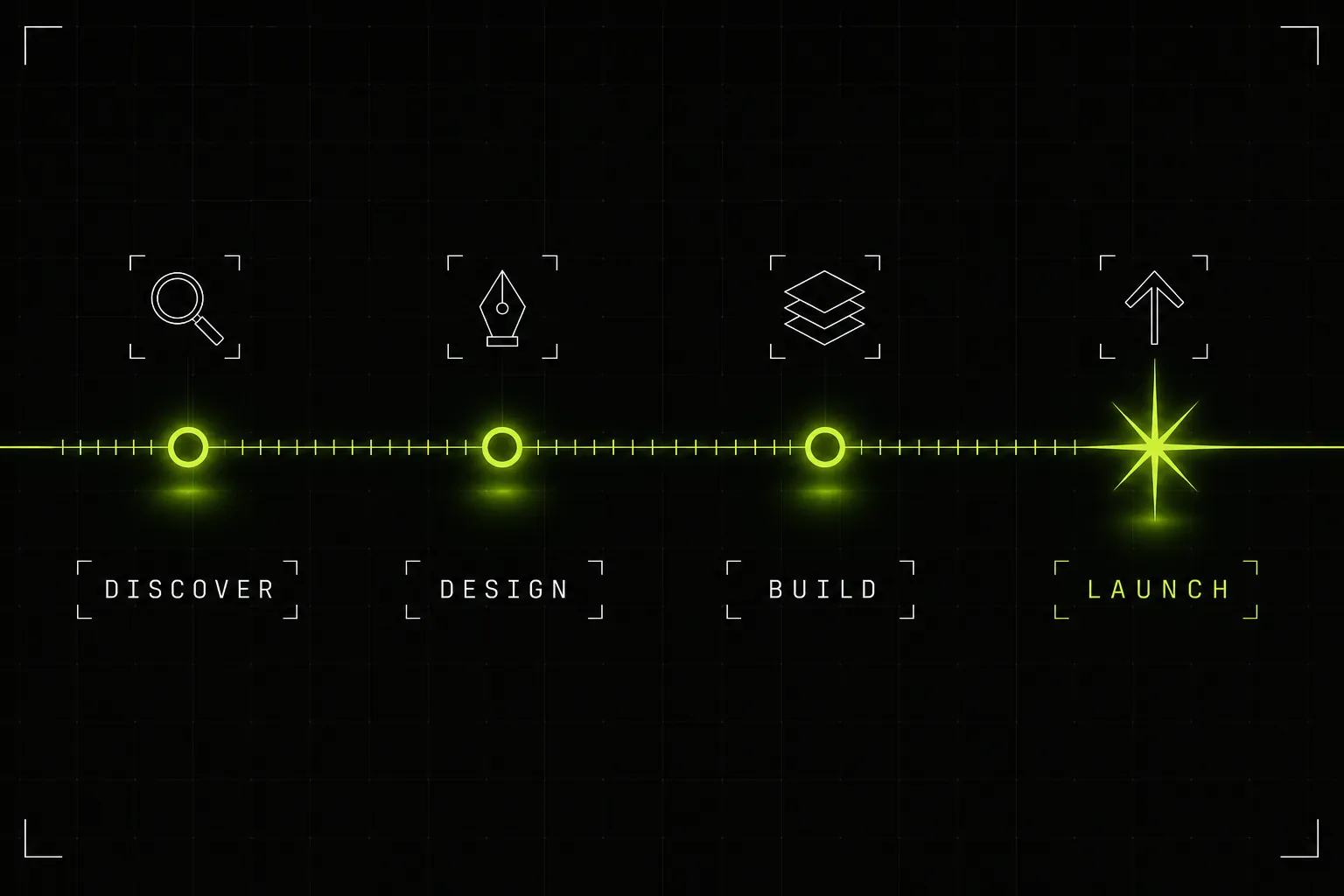
Four phases. The calendar time between them is where projects are won or lost.
Timelines by project type
These are realistic ranges for a competent agency working on a properly scoped project, assuming content arrives on time. The low end assumes a focused team and a decisive client; the high end assumes complexity, committee decisions, or both.
| Project type | Realistic timeline | What drives the range |
|---|---|---|
| Landing page | 3 days to 1 week | One page, one goal. Fast if the copy and offer are already decided. |
| Small business site (5 to 10 pages) | 2 to 6 weeks | Design ambition and whether content is ready. This is the most common project. |
| Marketing site with CMS (10 to 25 pages) | 6 to 10 weeks | Custom design, CMS structure, blog and case study templates, integrations. |
| SaaS marketing site | 4 to 8 weeks | Positioning and narrative work upfront, then a fast build. Messaging takes the time. |
| Ecommerce store | 6 to 12 weeks | Catalogue size, product data quality, payment and shipping setup, migration. |
| Enterprise or heavily integrated build | 3 to 6 months | Stakeholder sign-off cycles, CRM and ERP integrations, security review, accessibility audit. |
What actually happens in each phase
Most of a build is not people typing code. For a typical small business site, here is roughly where the time goes.
| Phase | Share of time | What happens |
|---|---|---|
| Discover | 10 to 15% | Goals, audience, competitors, sitemap, and agreeing exactly what is being built. Skipping this is what causes redesigns six months later. |
| Design | 30 to 40% | Key page designs, then the rest of the system. Usually the phase with the most back and forth, and the one revision rounds inflate. |
| Build | 30 to 40% | Development, CMS setup, responsive behaviour, integrations, content population. |
| Launch | 10 to 15% | Cross-browser and device testing, performance, SEO fundamentals, redirects, analytics, then go live. |
Note that testing and launch is a real phase, not an afterthought. Compressing it is how sites go live with broken forms and missing redirects that quietly cost rankings.
The real reason projects run late
After enough builds, the pattern is hard to miss. Projects rarely overrun because development took longer than expected. They overrun because of content, and content is the client's side of the table.
The typical sequence: design is approved in week two, the build is ready for content in week three, and then the project sits for six weeks while page copy is written between other priorities. The agency is idle, the client feels the project has stalled, and the launch date moves twice. Nothing was technically wrong at any point.
The other four delay causes, in rough order of how often they bite:
- Decision by committee. Every additional approver adds days, and the effect compounds rather than adds. One empowered decision-maker is worth more than any project management tool.
- Scope added mid-project. "Could we also add a booking system?" is a new project wearing a small question. This is exactly why fixed scope and fixed price protect you.
- Unlimited revision rounds. Without a defined number, design can loop indefinitely. Two structured rounds beats endless informal tweaks.
- Third-party access. Domain registrar logins, hosting credentials, CRM API keys and analytics access. Chasing these at launch week is a classic avoidable delay.
How to genuinely speed it up
These are the things that move a launch date forward, in order of impact:
- Have your content ready before design starts. Not perfect, but written. This single change is worth more than everything else on this list combined.
- Appoint one decision-maker. Someone who can approve a design without convening a meeting.
- Agree scope in writing upfront. Page count, features, integrations and revision rounds. Then hold to it and put new ideas in a phase two list.
- Gather access early. Domain, hosting, analytics, CRM, and any tool that needs connecting. Do it in week one.
- Launch smaller and add later. Five strong pages live now beat fifteen pages live in four months. A CMS exists so you can keep adding.
- Book feedback slots in advance. Putting the review meetings in the calendar at kick-off prevents the three-day gaps that quietly become three weeks.
Why quoted timelines vary so much
When one agency says three weeks and another says four months for the same brief, the difference is usually not effort. It is how the work is queued.
A site needing roughly fifteen working days of actual effort can be delivered in three weeks by a small focused team, or spread across four months by a larger agency running your project alongside a dozen others, with your build waiting in a queue between each phase. Both are honest quotes. Only one of them means people are working on your site most days.
The question worth asking is not "when will it be finished?" but how many working days of effort is this, and how many other projects is the team carrying? The answer tells you whether the calendar time is work or waiting.
How we do it
We ship most fixed-price projects in 2 to 4 weeks. That is possible because scope is agreed in writing before we start, revision rounds are defined, and we ask for content upfront rather than hoping it arrives. It is a small team working on your project, not a queue position.
Timelines are quoted alongside the fixed price, so you know both numbers before any work begins. For what that costs, see our UK website cost guide, or read about our web design service. If you are weighing platforms first, start with Webflow vs WordPress, or browse every guide.
Frequently asked questions
How long does it take to build a website?
A standard business website of five to ten pages takes 2 to 6 weeks with a professional agency. A larger marketing site with custom design and a CMS runs 6 to 10 weeks. An ecommerce store takes 6 to 12 weeks depending on catalogue size, and an enterprise or heavily integrated build runs 3 to 6 months. At ZevGeeks most fixed-price projects ship in 2 to 4 weeks.
Why do some agencies quote 3 months for a small site?
Usually queueing rather than working. Larger agencies batch projects and your build sits waiting between phases, so a site needing 15 working days of actual effort spreads across 12 weeks of calendar time. Ask how many working days of effort the project takes and how many other projects share your team, not just the end date.
What is the single biggest cause of delay?
Content. Copy, images, product data and logins are almost always the bottleneck, and they are the client's responsibility. A build that could ship in three weeks routinely takes three months because page copy is still being written. Having content ready before design starts is the most effective thing you can do to hit a deadline.
Can a website be built in a week?
A landing page or a template-based single-page site, yes. A genuine multi-page business site, realistically no, not if you want research, considered design, proper build and testing rather than a rushed template fill. Anyone promising a full custom site in a week is either using a template or skipping quality assurance.
How long does a Shopify or ecommerce store take?
6 to 12 weeks for most UK stores. Catalogue size drives it more than design: 20 products across three collections is a very different job from 2,000 SKUs with variants. Migration from another platform, B2B pricing tiers and multi-channel syncing each add real time on top.
Does a faster build mean lower quality?
Not if the scope is fixed and the process is tight. Speed problems come from unclear scope, endless revision rounds and decisions made by committee, not from the building itself. A well-scoped project with one decision-maker and content ready ships quickly precisely because nothing stalls.