Make.com vs Zapier: which should you use?
We build client automations on both platforms, so this comparison is based on daily use, not affiliate commissions. Here's how they actually differ in 2026, with real numbers.
Quick answer: Make.com is cheaper and more powerful for complex, multi-step automations, with visual branching and far better value per operation. Zapier is easier to learn, supports more apps (8,000+ vs 2,500+), and is faster for simple two-step tasks. Most small businesses outgrow Zapier's pricing long before they outgrow Make's capability.
Make vs Zapier at a glance
| Make.com | Zapier | |
|---|---|---|
| Starting paid price | $9/month (10,000 credits) | $19.99/month (750 tasks) |
| Free plan | 1,000 credits/month | 100 tasks/month, 2-step only |
| App integrations | 2,500+ | 8,000+ |
| Learning curve | Steeper (visual canvas) | Gentler (linear steps) |
| Complex logic | Excellent, built in | Limited, costs extra tasks |
| Value at scale | Strong | Weak; costs climb steeply |
| Best for | Complex workflows, agencies, cost-sensitive scaling | Simple tasks, non-technical teams, rare apps |
How does the pricing actually compare?
Both platforms price in US dollars, and both look cheap at the entry tier. Make's Core plan is $9 a month billed annually for 10,000 credits (Make renamed operations to credits in August 2025, converting 1:1 with no price change), while Zapier's Professional plan starts at $19.99 for 750 tasks. Zapier does allow paid overage above your limit, capped at three times your plan allowance, but it does not publish the rate, so budget on the tier rather than the overage. The difference appears the moment your automations run at any real volume.
A worked example. Say you automate lead handling: a 5-step workflow (new enquiry, enrich, score, add to CRM, notify Slack) that runs 1,000 times a month.
- On Make: roughly 5 credits per run, so 5,000 credits a month. That fits inside Core at $9 per month.
- On Zapier: the trigger is free, so 4 tasks per run, 4,000 tasks a month. That overshoots the 2,000-task tier and lands on 5,000 tasks, costing $89 per month.
Same workflow, same volume, around seven times the price. This gap is the single most common reason businesses migrate from Zapier to Make, and it widens as you scale.
Which is easier to use?
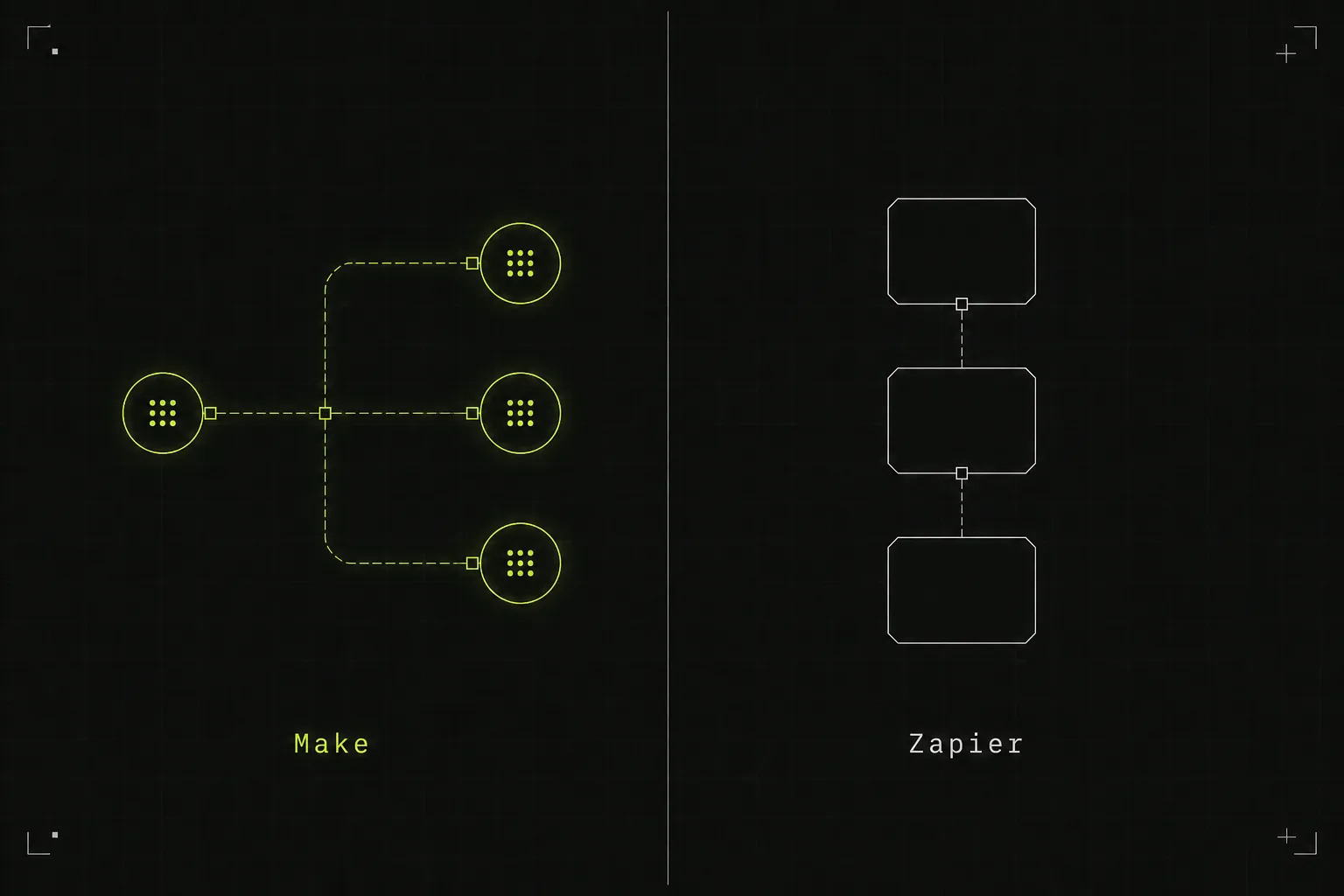
Zapier, clearly. Its linear trigger-then-action model matches how beginners think about automation, and the huge template library means someone with no technical background ships a working Zap in ten minutes. Make's canvas takes a few hours to click: you are looking at a flowchart of connected modules, and concepts like iterators and aggregators have a real learning curve. The payoff is that complex things stay manageable. A 20-step Zapier workflow becomes hard to reason about; a 20-module Make scenario is still a readable diagram.
Which is better for complex automations?
Make, and it isn't close.
- Branching: native routers split a scenario into unlimited paths. Zapier's paths exist but are clunkier and consume more tasks.
- Loops: Make's iterators process arrays natively (every line item in an order, every attachment in an email). Zapier's looping is a bolted-on feature.
- Data transformation: hundreds of built-in functions inline. In Zapier you often need a separate Formatter step, which is another task, every run.
- Error handling: per-module error routes (retry, ignore, roll back, alert). Zapier's error handling is basic on lower tiers.
If your automation is "when a form is submitted, add a row to a sheet", none of this matters. If it is "process this invoice, extract line items, match them against a PO, flag mismatches for review", Zapier will fight you and Make won't.
Which integrates with more apps?
Zapier, by a wide margin: 8,000+ apps against Make's 2,500+. If you rely on a niche tool, check both directories before deciding; this alone can settle the choice. The raw number matters less than it looks, though: both platforms cover the apps most businesses actually automate (Google Workspace, Outlook, Slack, HubSpot, Stripe, Shopify, Xero, Airtable, Notion), and both have generic HTTP modules that connect to anything with an API. Make's is more capable, which partly closes the directory gap for anyone slightly technical.
Which is better for AI workflows?
Both platforms integrated AI deeply through 2025 and 2026: native OpenAI and Anthropic modules, AI-assisted building, and agent-style features. The practical difference: Make is stronger for AI-heavy pipelines, where a workflow calls a model several times, branches on the result and loops over data, and credit pricing makes high-volume AI workflows dramatically cheaper to run. Zapier is stronger for AI-light additions, like drafting a reply inside an otherwise simple Zap. For the kind of AI automation we build for clients (lead qualification, document processing, customer service triage), Make is our default platform.
One 2026 change worth budgeting for: since 15 June 2026, Zapier bills AI steps by model tier rather than as a flat task. Standard counts as 1 task, Advanced as 3 and Premium as 5, and Advanced is the default for new AI steps. A single AI step can therefore triple what a Zap costs to run. In the worked example above, adding one Advanced AI step takes the workflow from 4,000 tasks to 6,000, pushing it off the 5,000-task tier and onto 10,000 at $129 a month. Zapier has also unified billing so AI steps, Code and the SDK all draw from the same task pool. On Make, a Code App step costs 2 credits per second of execution, which at this volume still fits inside Core.
When to choose Make
- Your workflows have more than 3 or 4 steps, or need branching and loops
- You run automations at volume and care what that costs
- You are building AI-powered workflows that call models repeatedly
- Someone on your team (or your agency) is comfortable with a visual builder
- You want granular error handling for business-critical processes
When to choose Zapier
- Your automations are simple, linear and low-volume
- Nobody technical will ever touch the tool
- You depend on a niche app that only Zapier supports
- You want the largest template library and gentlest onboarding
- Speed of setup matters more than monthly cost
Can you use both?
Yes, and plenty of businesses do: Zapier for quick, disposable connections a non-technical team member sets up in minutes, and Make for the heavy, business-critical workflows where volume and complexity live. There is no lock-in conflict; both tools connect to the same apps. That said, if you are starting fresh in 2026 and expect your automation footprint to grow, standardising on Make usually wins: one tool to learn, one place to monitor, and a pricing model that won't punish success. New to the topic? Start with what AI automation actually is, or see what it costs. If self-hosting is on the table, n8n vs Make covers the third option, and the best Zapier alternatives covers the rest of the field.
Frequently asked questions
Is Make.com really cheaper than Zapier?
At any meaningful volume, yes. Both platforms bill in US dollars. Make's Core plan includes 10,000 credits for $9 a month billed annually; Zapier's Professional starts at $19.99 for 750 tasks. For a 5-step workflow running 1,000 times a month, Make stays on Core at $9 while Zapier needs its 5,000-task tier at $89. That is roughly ten times the cost for the same automation.
Is Make.com hard to learn?
Harder than Zapier, but not hard in absolute terms. Expect a few hours to get comfortable with the canvas and a weekend to be genuinely productive. Non-technical users can absolutely learn it; they just will not ship their first workflow in ten minutes the way they would on Zapier.
Can I migrate from Zapier to Make?
Yes, but it is a rebuild, not an import. Each Zap is recreated as a Make scenario. Most migrations are straightforward because the connected apps are the same, and rebuilds often end up simpler because Make handles logic natively. A typical small business with 10 to 20 Zaps migrates in a few days of work.
Which is better for small businesses?
If your needs are simple and low-volume, Zapier's ease of use wins. If automation is becoming part of how the business runs, Make wins on cost and capability. The honest tipping point: once you are paying Zapier more than about $50 a month, price up the same workflows on Make.
Do agencies use Make or Zapier?
Mostly Make. Agencies build complex, high-volume workflows where Make's credit pricing, branching and error handling matter, and client costs stay predictable. We build on both but default to Make for anything beyond simple linear tasks.