n8n vs Make: an honest comparison
We build on both, so we have no side to take. Almost every comparison of these two argues about features. The features barely differ. What differs is how each one counts your usage, and that single decision determines which is cheaper by a factor of five in either direction.
Quick answer: Make bills every step of a workflow, n8n bills the whole workflow once. So many simple automations are far cheaper on Make, and a few complex ones are far cheaper on n8n. n8n can also be self-hosted for free, but it is not open source and its licence forbids reselling it as a hosted service. Make is easier to learn, n8n is more powerful once you can write a little code.
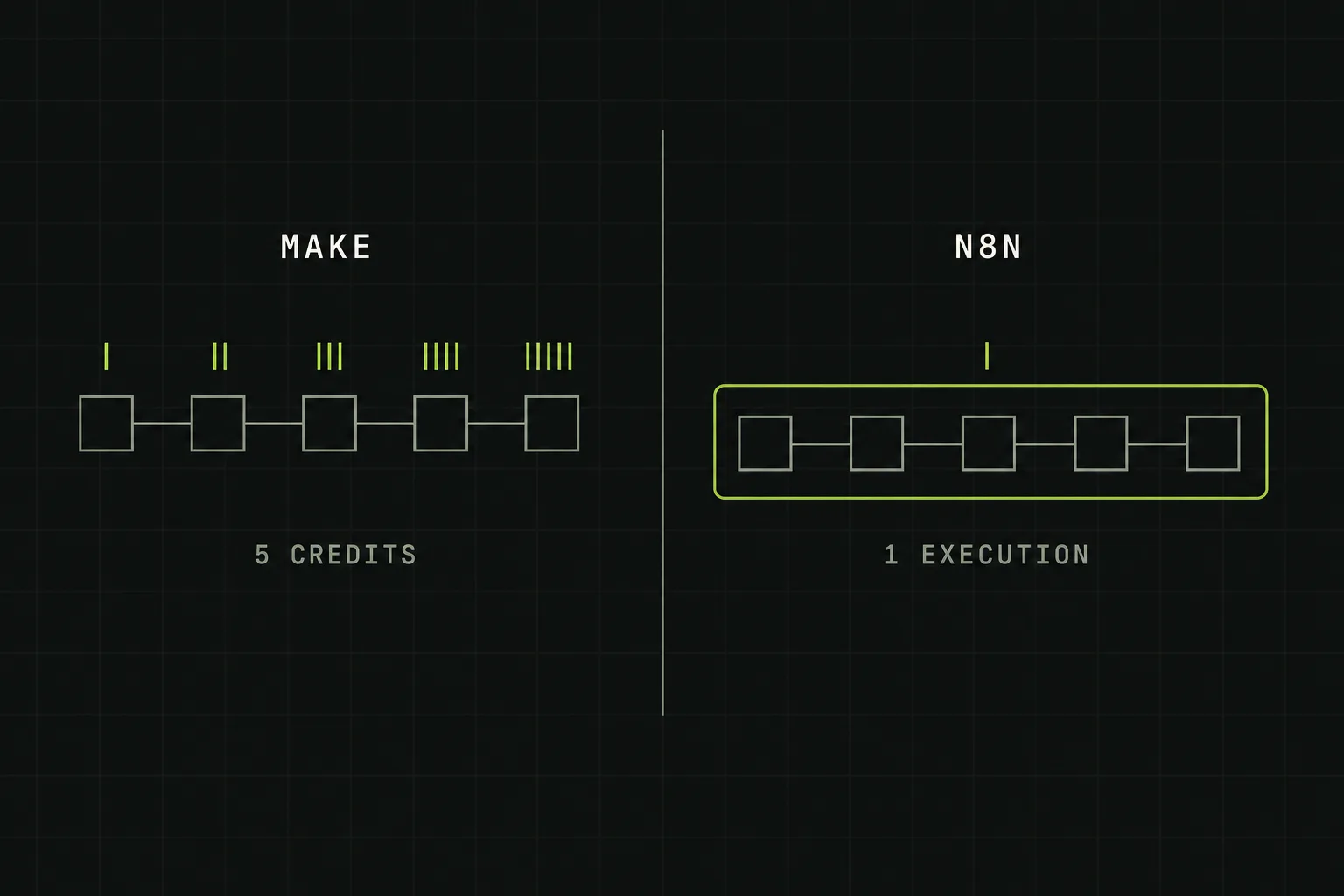
Same workflow, same run, two entirely different meters.
The billing difference that decides everything
Make charges one credit per module run. A scenario with eight modules that fires once consumes eight credits. Make renamed operations to credits in August 2025, converting one for one with no price change, so older guides using the word operations are describing the same meter.
n8n charges one execution per workflow run, regardless of how many nodes it contains. An eight-node workflow that fires once consumes one execution. So does an eighty-node one.
That is the entire comparison in two sentences, and it means the honest answer to which is cheaper is a question, not a number: how many steps does your average workflow have, and how often does it run?
Current pricing, side by side
Both are quoted on annual billing, which is how each publishes its headline figure. Note that Make prices in US dollars and n8n in euros.
| Tier | Make | n8n Cloud |
|---|---|---|
| Free | $0, 1,000 credits a month, 2 active scenarios, 15-minute minimum interval | No free cloud tier. Self-hosting is the free route. |
| Entry | Core, $9 a month, 10,000 credits, unlimited active scenarios, 1-minute interval | Starter, €20 a month (€240 a year), 2,500 executions, 5 concurrent |
| Mid | Pro, $16 a month, 10,000 credits, longer log retention | Pro, €50 a month (€600 a year), 10,000 executions, 20 concurrent |
| Team | Teams, $29 a month, 10,000 credits | Business, €667 a month (€8,004 a year), 40,000 executions, self-host option |
| Enterprise | Custom | Custom, 200+ concurrent executions |
| More volume | Credit bundles step up 10k, 20k, 40k, 80k, 150k and beyond, priced on a slider | Unlimited executions if you self-host the community edition |
Two things worth pulling out of that table. Every n8n plan includes unlimited users and unlimited workflows, which matters if a team wants to build freely without watching a seat count. And Make's prices above 10,000 credits move on a slider rather than a published tier list, so check the current figure for your volume rather than extrapolating from the Core price.
Two worked examples that flip the answer
The same two platforms, two realistic workloads, and opposite conclusions.
Example one: a simple automation running constantly. A 3-step workflow that watches a form, enriches the submission and writes it to a CRM, firing 3,000 times a month.
- Make: 3 × 3,000 = 9,000 credits, comfortably inside the 10,000 included on Core at $9 a month.
- n8n: 3,000 executions exceeds Starter's 2,500, so you are on Pro at €50 a month.
Make is roughly five times cheaper, for identical work.
Example two: a complex automation running moderately. A 20-step workflow that processes an order, checks stock, updates accounting, notifies the warehouse and handles three branching conditions, firing 2,000 times a month.
- Make: 20 × 2,000 = 40,000 credits, four bundle steps above the Core allowance.
- n8n: 2,000 executions fits inside Starter's 2,500, so €20 a month.
Now n8n is the cheap one, on a workload that is objectively larger. The rough crossover sits around four steps per run: below that, Make's meter is kind to you, above it, n8n's is. Count your average step depth before you count anything else.
The licence question nobody mentions
n8n is frequently described as open source. It is not, and n8n itself is careful about this. The source is published under the Sustainable Use Licence, which n8n calls fair-code: source-available with restrictions on commercial use. The Open Source Initiative's definition does not permit use restrictions, so the term open source does not apply.
In practice:
| Allowed | Not allowed without a commercial agreement |
|---|---|
| Running n8n inside your own business, free, on your own servers, modified however you like | Hosting n8n and charging others for access to it |
| Building automations for clients and charging for that work | White-labelling n8n and selling it as your own product |
| Selling consulting, support and training around n8n | Offering n8n as a hosted SaaS to third parties |
For most businesses this changes nothing. It matters if you were planning to run one n8n instance and resell access to your clients, which is a common idea and a licence breach. Agencies building and handing over workflows are firmly in the permitted column, which is the arrangement we use.
What self-hosting actually costs
Free licence, real bill. Self-hosting n8n is genuinely the cheapest option at volume, and the cost simply moves from a subscription line to an infrastructure and attention line.
- Server: roughly £5 to £40 a month. A small VPS handles hundreds of daily workflow runs. Memory becomes the constraint before CPU does.
- Database and queue: Postgres rather than the default SQLite once you are past hobby volume, and queue mode with Redis once concurrency matters.
- Upkeep: upgrades, backups, TLS certificates, monitoring and the occasional migration that needs attention. This is the line that catches people out.
- Recovery: when it stops at 2am, it stops until someone fixes it. There is no support queue.
The honest test: if nobody in the business would be comfortable restoring the instance from a backup, self-hosting is not free, it is deferred. n8n Cloud at €20 a month is cheaper than an afternoon of anybody's time.
Where each genuinely wins
| Make | n8n | |
|---|---|---|
| Billing unit | Per module run | Per workflow execution |
| Learning curve | Gentler, more forgiving builder, more beginner material | Steeper, assumes comfort with JSON and the occasional code node |
| App coverage | Broader catalogue of polished, maintained integrations | Good coverage, plus generic HTTP nodes for anything missing |
| Custom code | Possible, but you are working around the visual model | First class. Code nodes are a normal part of the design |
| Self-hosting | Not available | Yes, free, unlimited executions |
| Data residency | Make's infrastructure only | Wherever you host it. The deciding factor in regulated sectors |
| Users and workflows | Active scenario limits on free, unlimited from Core | Unlimited users and workflows on every plan |
| Licence | Commercial SaaS, no ambiguity | Fair-code, restrictions on reselling and hosting for others |
Which should you choose?
| If this is you | Choose |
|---|---|
| Non-technical team, mostly short automations, want it working this week | Make |
| Long multi-step workflows with lots of branching | n8n |
| Data cannot leave your infrastructure or your jurisdiction | n8n, self-hosted |
| Developers in the team who will want code nodes | n8n |
| High run counts on simple logic | Make |
| Nobody available to maintain a server | Make, or n8n Cloud |
| Planning to resell automation access to your own customers | Not self-hosted n8n. Read the licence first |
How we use both
We start from the workload rather than the platform. Short, high-frequency automations go on Make because the meter suits them and a client's own team can maintain them. Long, branching, code-adjacent workflows go on n8n, self-hosted when data residency or volume justifies it. Either way the automations are built in your account, under your ownership, so nothing is hostage to us.
Still comparing the mainstream options? Make vs Zapier covers that with a worked cost example, and the best Zapier alternatives covers the wider field including the genuinely open source options. For what automation costs to have built, see the UK AI automation cost guide, or start with what AI automation actually is. What we build is on our AI automation service page.
Frequently asked questions
Is n8n cheaper than Make?
It depends entirely on how many steps your workflows have. Make bills every module run as a credit, so a 20-step workflow costs 20 credits each time it fires. n8n bills one execution per workflow run no matter how many nodes it contains. Few complex workflows are cheaper on n8n. Many simple workflows are cheaper on Make, often by several times.
Is n8n open source?
No, and n8n does not claim to be. The source is available under the Sustainable Use Licence, which n8n describes as fair-code. You may use, modify and self-host it inside your own business for free, but you may not resell it, white-label it, or host it and charge others for access without a separate commercial agreement. Building automations for clients is explicitly allowed.
Is self-hosted n8n really free?
The licence is free, the running of it is not. Budget £5 to £40 a month for a server capable of hosting it, plus the time to handle upgrades, backups, monitoring, queue mode when volume grows and the occasional broken migration. If nobody in the business is comfortable with that, the hosted plan is cheaper than the hours you will spend.
Which is easier to learn, n8n or Make?
Make, clearly, for someone who does not write code. Its visual builder is more forgiving, its error handling is easier to reason about and there is far more beginner material available. n8n rewards people who are comfortable dropping into a Code node and thinking in JSON, and becomes the faster tool once you are.
Can n8n and Make do the same things?
For the majority of business automation, yes. Both connect to the common business tools, both branch and loop, both handle webhooks, and both have solid AI and agent features in 2026. The genuine divergences are self-hosting and data residency, which only n8n offers, and app coverage plus polish, where Make is ahead.
Should I move from Zapier to n8n or Make?
Move to Make if you want a similar experience with substantially better value per step and better handling of complex branching. Move to n8n if cost at volume, self-hosting or data residency is the reason you are leaving. If you are still deciding between the mainstream options first, our Make vs Zapier comparison covers that ground.