The best Zapier alternatives in 2026
Almost nobody leaves Zapier because of what it can do. They leave because of how it counts. Here are the seven credible alternatives, which of them are genuinely free, which are actually open source rather than merely described that way, and what breaks on the way out.
Quick answer: for most businesses the alternative is Make.com, which does the same job at roughly a tenth of the cost at volume. If you need self-hosting or data residency, it is n8n. If you specifically need a real open source licence, it is Activepieces. If you already pay for Microsoft 365, check Power Automate before buying anything. Everything else on this page is a narrower fit.
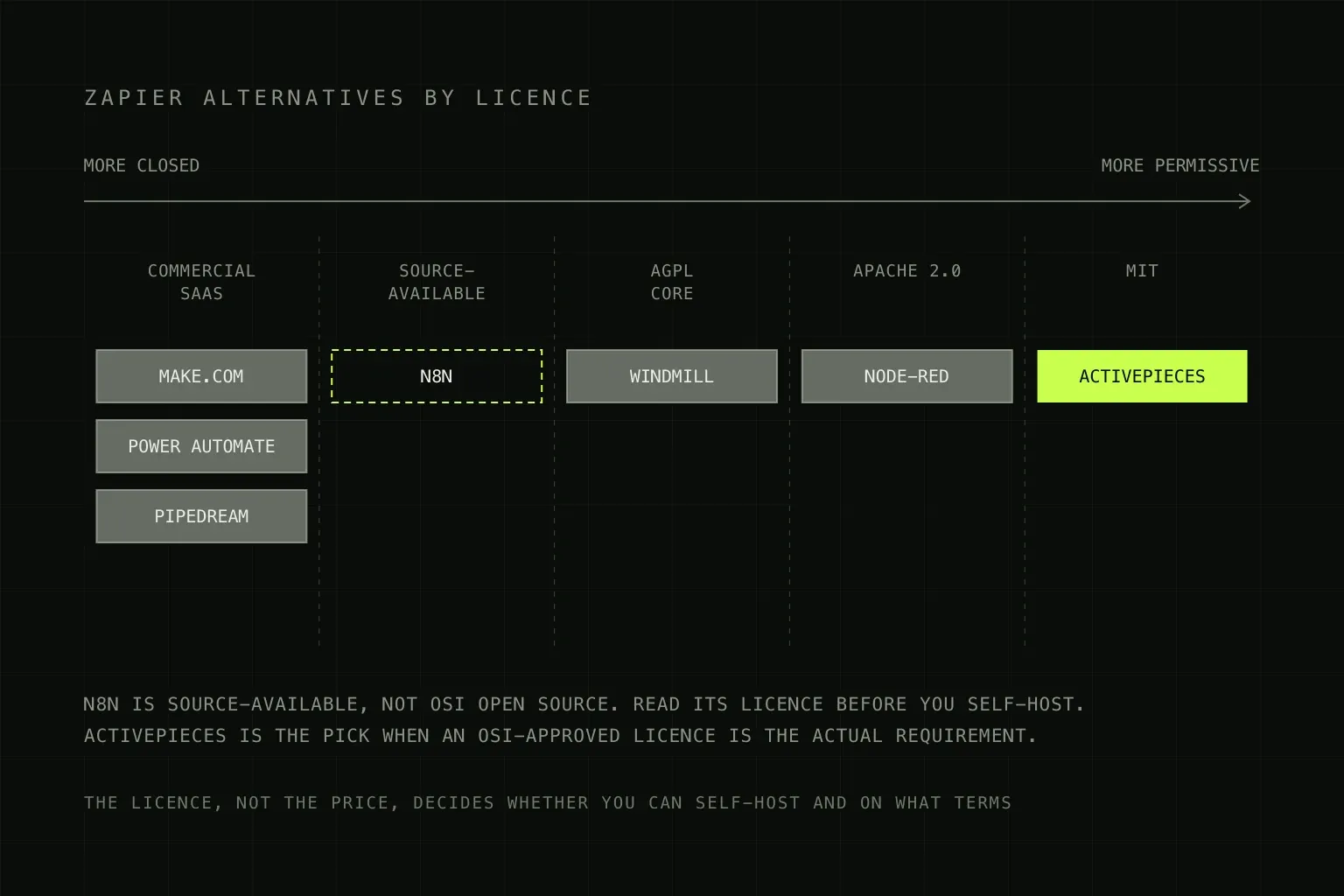
Arranged by licence, not by price. The two get confused constantly.
Why people actually leave Zapier
Zapier bills per task, and a task is one action step. The trigger is free, every step after it is metered, and this is charged on every single run. That model is generous to a two-step automation and brutal to anything real.
The worked example we use elsewhere: a 5-step workflow running 1,000 times a month consumes 4,000 tasks, which overshoots the 2,000-task tier and lands on 5,000 at $89 a month. The same workflow on Make consumes about 5,000 credits, comfortably inside Core at $9 a month. Roughly seven times the price for identical work, and the gap widens as you grow.
One 2026 change made this sharper. Since 15 June 2026, Zapier bills AI steps by model tier rather than as a flat task: Standard counts as 1, Advanced as 3, Premium as 5, and Advanced is the default for new AI steps. Adding a single AI step to that example takes it from 4,000 tasks to 6,000, pushing it onto the 10,000-task tier at $129. A lot of people discovered their alternative research was overdue when that invoice arrived.
The honest tipping point: once you are paying Zapier more than about $50 a month, price the same workflows elsewhere. Below that, the disruption of moving usually costs more than it saves.
The seven alternatives
| Tool | Billing model | Licence | Best for |
|---|---|---|---|
| Make.com | Per module run (credit). Core from $9 a month for 10,000 credits | Commercial SaaS | The default replacement. Same job, far better value, visual branching and loops that Zapier fights you on |
| n8n | Per workflow execution regardless of step count. Cloud from €20 a month, or free self-hosted | Source-available, fair-code | Long multi-step workflows, self-hosting, data residency, teams with a developer |
| Activepieces | Cloud tiers, or free self-hosted | MIT, genuinely open source | When the licence is the requirement. Smaller connector catalogue than the two above |
| Power Automate | Per user per month, with some capability bundled into Microsoft 365 plans | Commercial SaaS | Microsoft-heavy organisations. Check what your existing licences already include before paying again |
| Pipedream | Credit-based, code-first with a generous developer free tier | Commercial SaaS | Developers who would rather write a few lines than configure a module |
| Windmill | Self-hosted free, cloud tiers available | AGPL core | Turning scripts into internal tools and scheduled jobs. Closer to a developer platform than a no-code builder |
| Node-RED | Free. You provide the server | Apache 2.0 | Event and device wiring, IoT, local network jobs. Not a business SaaS connector tool, despite the visual similarity |
Prices above 10,000 credits on Make move on a slider rather than a published tier list, and every vendor here changes pricing more often than guides get updated. Treat these as the shape of each deal rather than a quote, and check the current figure for your volume.
What "free" actually means
Free is the most searched qualifier on this topic and the most misleading. There are three genuinely different things being called free.
- A free tier on a hosted platform.Make gives 1,000 credits a month across two active scenarios, with a 15-minute minimum interval. That is real and it is enough to run one or two light automations permanently. Zapier's own free tier is limited to single-step Zaps, which is why people looking for free are usually already looking to leave.
- Free software you host yourself. n8n, Activepieces, Windmill and Node-RED all cost nothing to license for internal use. The bill moves rather than disappearing: a server at roughly £5 to £40 a month, Postgres instead of SQLite once you are past hobby volume, plus upgrades, backups, TLS and monitoring.
- Free until it isn't. Trials, and tiers that are free at volumes no working business stays under. Check what the second month costs, not the first.
The honest test for self-hosting: if nobody in the business would be comfortable restoring the instance from a backup, it is not free, it is deferred.n8n Cloud at €20 a month is cheaper than an afternoon of anyone's time.
Open source, and the part vendors are vague about
"Open source Zapier alternative" is a popular search and a partly false premise, because the most popular answer to it is not open source.
n8n publishes its source under the Sustainable Use Licence, which n8n itself describes as fair-code, not open source. The Open Source Initiative's definition does not permit restrictions on commercial use, and this licence has them. In practice you may run and modify n8n inside your own business for free, and build automations for clients and charge for that work. You may not host it and sell others access, or white-label it as your own product. For most businesses this changes nothing. It matters enormously if your plan was to run one instance and resell access to your customers, which is a common idea and a licence breach. Our n8n vs Make comparison sets out the permitted and forbidden columns in full.
If the licence itself is your requirement, rather than the price, then Activepieces (MIT), Node-RED (Apache 2.0) and Windmill (AGPL core) are the ones that meet the standard definition. Be clear with yourself about which you actually need: most people searching for open source want free and not locked in, and self-hosted n8n delivers that regardless of what the licence is called.
Which should you pick?
| If this is you | Choose |
|---|---|
| Zapier works, it is just too expensive, and nobody here writes code | Make.com |
| Workflows are long, with lots of branching, running at moderate frequency | n8n. Its meter ignores step count |
| Short workflows firing thousands of times a month | Make. Below about four steps per run, its meter is the kinder one |
| Data cannot leave your infrastructure or your jurisdiction | n8n, Activepieces or Windmill, self-hosted |
| You need an OSI-approved licence specifically | Activepieces |
| Already paying for Microsoft 365 across the business | Power Automate, after checking what your licences already cover |
| Your team writes code and finds visual builders slower than typing | Pipedream or Windmill |
| Nobody available to maintain a server | Any hosted option. Do not self-host |
| You plan to resell automation access to your own customers | Not self-hosted n8n. Read its licence first |
The two comparisons behind most of these rows are Make vs Zapier, which has the full cost arithmetic, and n8n vs Make, which explains the step-count crossover in detail.
What migration actually involves
There is no import button anywhere in this market. Every workflow is rebuilt by hand. That is less painful than it sounds, because rebuilding forces you to notice the four Zaps nobody has needed since 2024. Budget an hour or two per workflow for anything straightforward.
The four things that genuinely catch people out:
- OAuth connections. Every service needs fresh authorisation on the new platform. Where a connection was made by someone who has since left, this becomes an access problem before it becomes a migration problem.
- Webhook URLs change. Anything pointing at a Zapier catch hook must be repointed: form tools, payment providers, other people's systems. Find every one of them before you switch anything off.
- Formatter steps have no single equivalent. Zapier's Formatter is one step doing many small jobs. Elsewhere that logic is inline functions or a code node. Easier, and different enough to slow you down the first time.
- Silent failure. A rebuilt workflow that is subtly wrong does not announce itself. Run both platforms in parallel for a week, compare the outputs, and only then turn Zapier off.
Do the highest-volume workflow first, not the easiest one. It is the one paying for the migration, and it will surface every problem the others would have hidden.
How we choose for clients
We start from the workload rather than the brand. Short, high-frequency automations go on Make, where the meter suits them and a client's own team can maintain them. Long, branching, code-adjacent workflows go on n8n, self-hosted when data residency or volume justifies it. Occasionally the right answer is to stay on Zapier, because the bill is small and switching would cost more than it saves.
Either way, it is built in your account, under your ownership. For what a build costs, see the UK AI automation cost guide. If you are choosing who does the work, how to hire an AI automation expert covers the questions worth asking. What we build is on our AI automation service page.
Frequently asked questions
What is the best free alternative to Zapier?
Make.com has the most usable free tier of the hosted options: 1,000 credits a month across two active scenarios. If free must mean free forever at any volume, the answer is self-hosting n8n or Activepieces, where the software costs nothing and you pay for a server instead, roughly £5 to £40 a month plus your own time.
Is there an open source Zapier alternative?
Yes, but fewer than the marketing suggests. Activepieces (MIT), Node-RED (Apache 2.0) and Windmill (AGPL for the core) meet the Open Source Initiative definition. n8n does not: it is source-available under the Sustainable Use Licence, which n8n itself calls fair-code. You can self-host n8n free inside your own business, but you may not resell access to it.
Why is Zapier so expensive?
Because it bills per task, and a task is one action step, so every step of every run is metered. A 5-step workflow running 1,000 times a month consumes 4,000 tasks, which lands on a tier costing around $89 a month. The same workflow on Make costs roughly 5,000 credits, inside the $9 Core plan. Since June 2026 Zapier also bills AI steps at up to five tasks each, which can triple the cost of a workflow that added one AI step.
Should I switch from Zapier to Make?
If you are paying Zapier more than about $50 a month, price the same workflows on Make before renewing. Make is cheaper at volume and better at branching and looping, at the cost of a steeper first few hours. If your automations are simple, low-volume and working, switching to save $20 a month is not worth the disruption.
Can I self-host a Zapier alternative?
Yes. n8n, Activepieces, Windmill and Node-RED all run on your own server. The licence is free; the running of it is not. Budget for a server, a Postgres database once you are past hobby volume, upgrades, backups, monitoring, and the fact that when it stops at 2am it stays stopped until someone fixes it. Self-hosting is genuinely cheapest at high volume and genuinely more expensive at low volume once you count time.
What breaks when you migrate away from Zapier?
There is no import button, so every workflow is rebuilt by hand. The things that actually catch people out are OAuth connections needing fresh authorisation on the new platform, webhook URLs changing so every upstream system pointing at them must be updated, and Zapier's built-in Formatter steps having no single equivalent elsewhere. Run both platforms in parallel for a week before switching anything off.