How to hire an AI automation expert
The field is two years old, has no qualifications, and is full of people who learned it last month from a course they are now also selling. Here is how to tell a builder from a demo merchant, what each hiring route really costs in the UK, and the one contract clause that matters more than the price.
Quick answer: for one defined problem, hire a freelancer at £300 to £500 a day. For several connected processes, or if you do not yet know what is worth automating, hire an agency at £1,500 to £6,000 for a project. Hire in-house only once automation is a permanent function rather than a project. Whichever you choose, the workflows must be built in your platform account, not theirs.
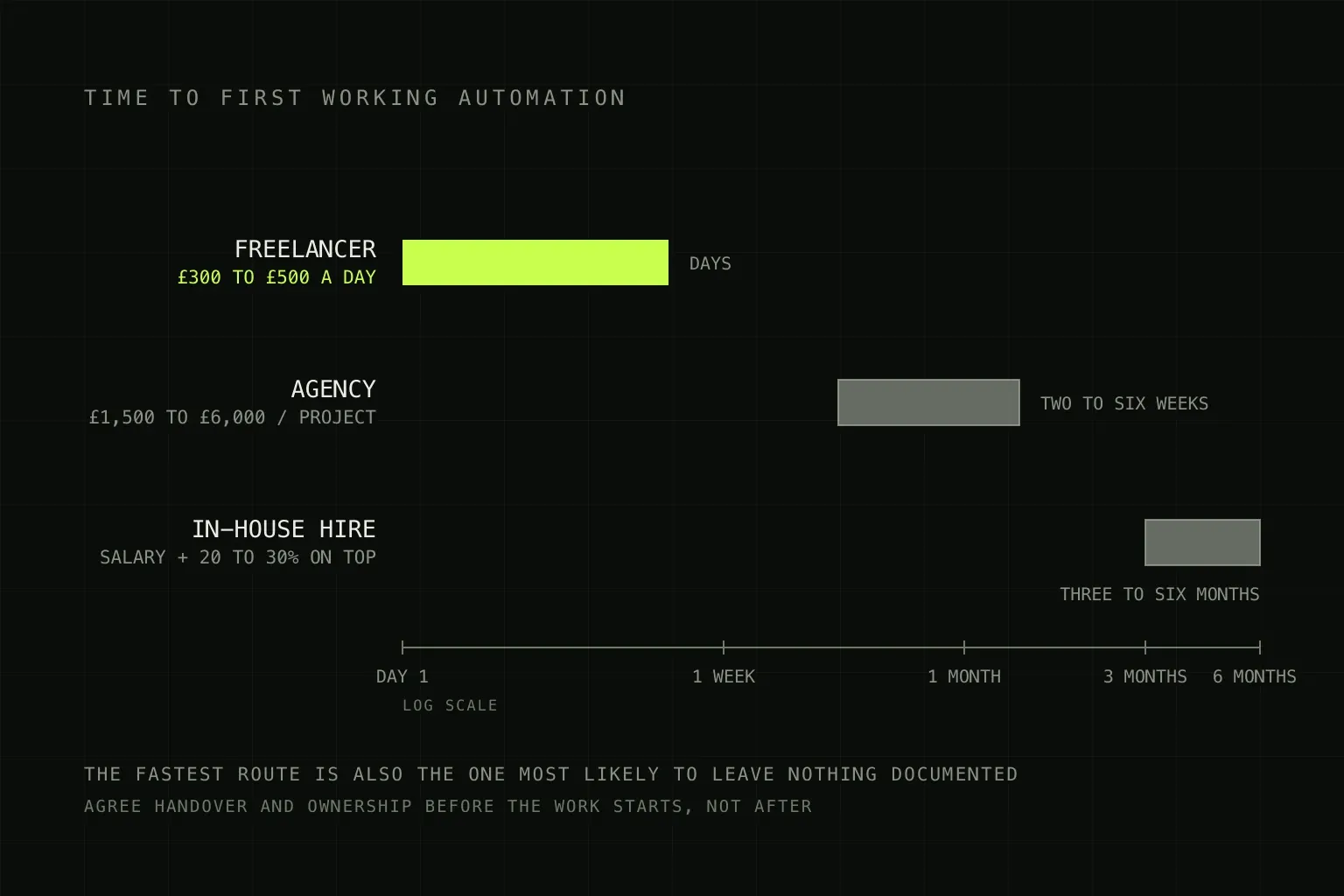
Time to the first working automation, which is usually the real constraint.
First, work out what you are actually hiring for
"AI automation expert" covers at least four different jobs, and hiring the wrong one is the most expensive mistake available to you. The distinctions matter because each has a different rate and a different failure mode.
| The role | What they actually do | Hire them when |
|---|---|---|
| Automation specialist | Connects the tools you already pay for, using Make, n8n, Zapier or Power Automate. The skill is process design and edge cases, not code. | The work is repetitive, the tools already exist, and the problem is that a human is moving data between them. |
| AI integration engineer | The above, plus language models doing the judgement steps: classifying enquiries, extracting fields from documents, drafting replies. | A step in the process currently requires reading something and deciding what it means. |
| Software developer | Builds things that do not exist. Custom APIs, internal tools, anything no off-the-shelf product covers. | You have genuinely established that connecting existing tools cannot do it. Verify that claim before accepting it. |
| Data or ML engineer | Pipelines, model training, evaluation. A different discipline that happens to share the letters A and I. | You are building a model on your own data. Almost no SME needs this, and it is frequently mis-sold to those who don't. |
Most UK small businesses asking this question need the first or second row. If someone in the first row quotes you like the third, or someone in the third row is scoped onto a job the first row could do in two days, you are overpaying by an order of magnitude. A quick read of what AI automation actually is will tell you which row your problem sits in.
The three hiring routes, honestly compared
| Freelancer | Agency | In-house | |
|---|---|---|---|
| Typical UK cost | £300 to £500 a day, or £500 to £1,500 per workflow | £1,500 to £6,000 per project, boutique. £15,000 upward at consultancy scale | Salary plus roughly 20 to 30 percent in employer NI, pension and overhead |
| Time to first working thing | Days. The fastest route by some distance | Two to six weeks including discovery | Three to six months from posting the role |
| Best at | One problem you can already describe precisely | Working out which problems are worth solving, then solving several | Continuous change, deep domain knowledge, compliance-sensitive data |
| Fails when | They move on and nobody documented anything | You are sold a retainer for workflows that needed none | Volume of work does not justify a full-time salary, which is usually |
| Who fixes it at 2am | Nobody, unless you agreed that in advance | Whoever the support agreement names. Get it in writing | Your employee, if they are still employed |
The in-house column deserves a blunt note. A permanent automation hire only pays for itself when there is a continuous queue of work. Most SMEs have a burst of five or six valuable automations and then a long quiet period of small tweaks. Hiring a salary against that shape is how businesses end up inventing automation projects to justify a headcount. Revisit it once the queue genuinely never empties.
The seven questions to ask
Every one of these is designed so that a competent person answers immediately and a demo merchant changes the subject.
- "Whose account will the workflows live in?" The only correct answer is yours. Anything else is worth ending the conversation over. This is covered again below because it matters more than price.
- "What happens when this workflow fails at 3am?" Listen for specifics: error routes, retries, a notification going to a named human, a way to replay the failed run. Vague reassurance means they have not built anything that ran long enough to fail.
- "Which platform, and why that one for this job?" The reasoning matters more than the answer. Somebody who recommends the same platform for every problem is selling what they know rather than what fits. Our own reasoning is set out in Make vs Zapier and n8n vs Make.
- "What will this cost to run per month, after you have finished?" They should be able to estimate platform and AI usage. If they cannot, they have not thought about how many steps their design burns per run, which is the difference between a £9 and a £129 monthly bill on the same automation.
- "Show me something you built that is still running." Not a screen recording of a workflow being built. Something in production, with an owner who can be asked about it. Under NDA, a redacted description of the process and its failure rate is a fair substitute.
- "What in my list would you tell me not to automate?"The single most revealing question. Anyone who says everything on your list is a great candidate is selling. Real answers sound like "that one runs four times a month, the automation will cost more than the time it saves".
- "What do I get at the end, besides a working workflow?" Documentation, a diagram, credentials in your own vault, and a handover session. If the deliverable is only the workflow, you have bought a dependency rather than an asset.
Red flags
- The portfolio is all builder screenshots. Anyone can drag modules onto a canvas. Ask what it does and how often it runs.
- They also sell a course on becoming an AI automation agency. Not automatically disqualifying, but ask which is the main business. UK search data for this term is dominated by people wanting to start one of these agencies rather than hire one, and a share of the market is teaching the trade rather than practising it.
- A mandatory retainer attached to a simple build. A well-documented workflow with proper error handling runs unattended for months. Retainers are legitimate when processes change often; retainers on static workflows are rent.
- "AI agents" as the answer to everything. Agents are genuinely useful for open-ended judgement. For "copy this order into the accounting system" they add cost, latency and a new way to be wrong.
- No questions about your data. Where customer records go, which jurisdiction they are processed in, and what the model provider retains are UK GDPR matters. Silence on this is not diligence you want to supply yourself.
- A price before a conversation. A number quoted from a one-line brief is a guess that will be revised upward, or a scope so narrow it will not solve the problem.
The clause that matters more than the price
Automation platform accounts are where the leverage lives. If the Make, n8n or Zapier account is in the contractor's name, then every workflow you paid for sits behind their login, on their card, and your processes stop the day the relationship does. This is common, it is rarely malicious, and it is entirely avoidable.
Insist on all four:
- The platform account is registered to your company, billed to your company.
- The person you hire is added as a collaborator you can remove.
- API keys and credentials for your own tools are created by you and held in your password manager.
- Documentation and workflow exports are handed over on completion, not on request.
None of this is unreasonable, and it costs nothing to arrange at the start. Ask for it after the build and you are negotiating from the weaker position. Everything we build for clients sits in their own accounts for exactly this reason.
What to have ready before you approach anyone
You will get better quotes, faster, from anyone competent if you arrive with these four things. None require technical knowledge.
- The process written down as it happens today. Who does it, in what order, with which tool at each step. Screenshots are fine. Perfection is not required, and the gaps you discover writing it are frequently the actual problem.
- How often it runs. Times per day or per week. This single number decides both the platform and whether the automation is worth building at all.
- The tools involved, and who has admin on each. Access is the most common cause of a two-day build taking three weeks.
- What the current process costs you. Hours a week multiplied by a loaded hourly rate multiplied by 52. Six hours a week at £25 an hour is a £7,800 a year problem, which tells you instantly whether a £1,500 build is sensible.
If that last calculation does not clear the bar, the correct decision is not to automate it, and anyone worth hiring will say so on the first call. The AI automation cost guide works through the arithmetic in more detail.
How to structure the first engagement
Do not hand a stranger your six most important processes. Structure the first piece of work so that being wrong about them is cheap.
Start with one workflow that matters but is not critical. Something that saves real time and whose failure would be irritating rather than damaging. You learn how they communicate, whether they document, and whether the thing still works in week four, for a few hundred pounds rather than a few thousand.
Agree fixed price on a defined scope. Hourly billing on automation work rewards the slow discovery of complications. Fixed price on a written scope puts the estimating risk with the person who is qualified to estimate.
Define done in advance. Working in production, error handling in place, documented, credentials transferred, owner trained. Write those five words down; they prevent most disputes about whether a project finished.
How we work
We start with an audit rather than a build, because roughly half of what businesses arrive wanting to automate is not worth automating, and finding that out costs less than discovering it afterwards. Work is fixed price against a written scope, built in your platform accounts, documented and handed over. No mandatory retainer.
See what we build as an AI automation agency, or start with what AI automation actually is if the terminology is still doing more harm than good. If the business is a store, ecommerce automation is the more specific starting point.
Frequently asked questions
How much does it cost to hire an AI automation expert in the UK?
A freelancer typically charges £300 to £500 a day, or £500 to £1,500 for a single well-defined workflow. A boutique agency project covering an audit plus several connected workflows usually lands between £1,500 and £6,000. Enterprise consultancies start around £15,000. An in-house hire is a different shape of cost: salary plus employer National Insurance, pension and the months before they are productive.
Should I hire a freelancer or an agency?
Hire a freelancer when you have one clearly defined problem and someone internally who can specify it. Hire an agency when you do not yet know which processes are worth automating, when several workflows need to talk to each other, or when you need the thing to still work in a year without you chasing anyone. The deciding question is not price, it is who owns the problem when a workflow silently stops.
Do I need an AI automation expert or just a developer?
They solve different problems. A developer builds software that does not exist yet. An automation specialist connects software you already pay for, and the skill is knowing which processes are worth connecting and where the edge cases hide. Most small business automation needs the second person. If your requirement genuinely cannot be met by connecting existing tools, you need a developer, and you should be told that plainly.
What should I have ready before I approach anyone?
A written description of the process as it happens today, including who does it and how often, a rough count of how many times a week it runs, a list of the tools involved, and admin access to those tools. That is enough for anyone competent to scope the work. You do not need to know which platform to use; choosing it is part of what you are paying for.
How long should an AI automation project take?
A single workflow is usually days rather than weeks. An audit plus a handful of connected workflows typically runs two to six weeks, most of which is discovery and testing rather than building. Anyone promising a business-critical automation in 48 hours is describing a demo, not a system that survives contact with real data.
Who should own the automation accounts?
You should, without exception. The Make, n8n or Zapier account should be in your company's name, on your company's billing, with the person you hire added as a collaborator you can remove. If the workflows live in a contractor's account, you are renting your own processes and the leverage sits entirely on their side of the table.