What is AI automation?
If you've heard the term but aren't sure what it means for your business in practice, this guide explains it in plain English: what it is, what it isn't, what it can genuinely do, and what an agency actually does when you hire one.
Quick answer: AI automation combines workflow automation tools like Make.com or Zapier with AI models like ChatGPT and Claude, so software can handle tasks that previously needed human judgement: reading emails, qualifying leads, drafting replies, processing documents. Unlike traditional automation, it handles unstructured work, not just rule-based steps.
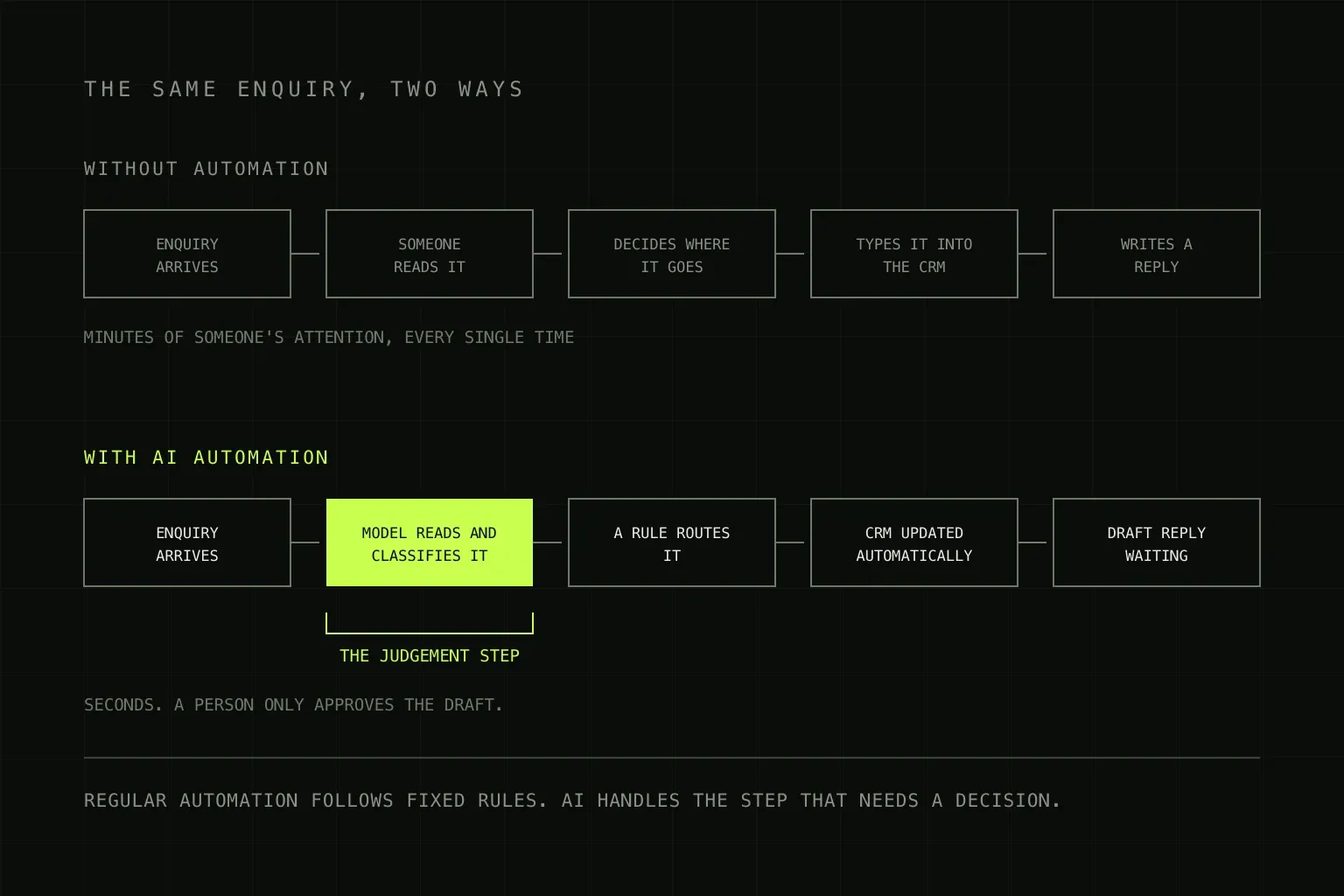
The highlighted step is the difference. Everything else was already automatable.
The plain-English version
Traditional automation follows rules you write in advance: when a form is submitted, add a row to a spreadsheet and send a confirmation email. It is reliable, but it only works when every input looks the same and every decision can be written as a rule.
AI automation adds a model that can read, interpret and decide. The workflow still runs on an automation platform, but somewhere in the middle an AI reads the actual content (an email, an invoice, a CV, a review) and makes a judgement a human used to make: what is this about, is it urgent, which category does it belong to, what should the reply say. The messy, judgement-heavy work that used to be "someone will get to it this afternoon" becomes something that happens in seconds, with a human checking the output instead of doing the work.
How is it different from regular automation?
| Traditional automation | AI automation | |
|---|---|---|
| Follows | Fixed rules | Rules plus judgement |
| Handles | Structured data (forms, fields) | Unstructured data (emails, documents, messages) |
| Decisions | Pre-written (if X then Y) | Interpreted (what does this mean, what matters here) |
| Example | New order, send receipt | New enquiry: read it, score it, draft a tailored reply |
| Breaks when | Input format changes | Rarely; it reads meaning, not format |
The two work together. Most useful workflows are a chain of traditional steps with one or two AI steps at the points that need judgement.
What can AI automation actually do for a business?
- Lead qualification. A new enquiry arrives; the AI reads it, scores fit against your ideal client profile, enriches it with company data, adds it to your CRM with a summary, and notifies you in Slack with a suggested reply. Hot leads get a response in minutes instead of hours.
- Invoice and document processing. Supplier invoices land in an inbox; the AI extracts line items, matches them against purchase orders, flags mismatches for review, and files the clean ones straight into Xero.
- Customer service triage. Incoming support emails are read, categorised, prioritised by urgency and sentiment, and routed to the right person with a drafted response ready to edit.
- Content repurposing. A blog post is published; the AI drafts a LinkedIn post, a newsletter section and social snippets in your tone of voice, staged for approval.
- Reporting. Numbers from your ad platforms, analytics and CRM are pulled weekly and summarised into a plain-English report. The AI writes the "so what", not just the totals.
Every example follows the same pattern: a trigger, some structured steps, an AI step where judgement lives, and a human approval point wherever the output goes to a customer.
What tools are used?
The workflows run on platforms like Make.com (our default for complex, high-volume work), Zapier (best known, strongest for simple workflows and its 8,000+ integrations) and n8n (source-available, for teams that want self-hosting). The AI models doing the reading and judging are OpenAI's ChatGPT and Anthropic's Claude, called from inside the workflows. The point is connecting the software you already use (Gmail or Outlook, your CRM, Xero, Slack, Shopify), not replacing it. For choosing between the two big platforms, see our Make vs Zapier comparison, or the wider field in the best Zapier alternatives.
What does an AI automation agency do?
Hiring an agency for this is not buying software; it is buying a working process. Ours looks like this:
- Discovery. Map how work actually flows through your business and find the tasks that are repetitive, high-volume and judgement-light: the automation sweet spot.
- Process design. Each workflow is designed on paper first: triggers, steps, where AI judges, where a human approves. You sign off the logic before anything is built.
- Build. The workflow is built on Make or Zapier, connected to your real tools, with prompts engineered and tested against your real data.
- Testing and handover. It runs in parallel with the manual process until you trust it, with documentation in plain English.
- Maintenance. Automations touch live tools that change; someone has to own that. We offer it fixed-price rather than as an open-ended retainer.
The value is knowing which processes are worth automating and building them so they fail safely. Anyone can connect ChatGPT to an inbox; the craft is in what happens when the AI meets an input it has never seen.
How do you know if a process is worth automating?
A checklist we use in discovery. A process is a strong candidate when it is:
- Repetitive: it happens the same basic way every time
- Frequent: at least daily or weekly, in real volume
- Rule-plus-judgement shaped: mostly mechanical with a small amount of reading and deciding
- Clearly bounded: you can describe the inputs and the correct outputs
- Tolerant of review: a human can check the output before it matters, at least at first
Weak candidates are rare tasks, high-stakes decisions with no review step, and work that requires genuine expertise and relationships. If a task makes someone in your business sigh "this again", it probably belongs on the first list. For what building this costs, see our AI automation cost guide, for who should build it see how to hire an AI automation expert, and if you run a store, ecommerce automation lists the eight processes worth automating first. Or see what we do as an AI automation agency in Glasgow.
Frequently asked questions
What is an example of AI automation?
A common one: a new enquiry arrives, an AI reads it, scores how well it fits your ideal customer, adds it to your CRM with a summary, and notifies your team with a drafted reply. The whole chain runs in seconds without anyone touching it.
Is AI automation the same as ChatGPT?
No. ChatGPT is a tool a person uses; AI automation is a system that runs without a person, using models like ChatGPT or Claude as one step inside an automated workflow. The difference is that nobody has to sit down, open a chat and ask.
How much does AI automation cost?
For UK small businesses, individual automations typically cost from a few hundred pounds to around £2,000 to build, plus platform fees usually under £50 a month. Complex multi-workflow systems cost more.
What is an AI automation agency?
An agency that designs, builds and maintains automated workflows combining tools like Make.com with AI models. The work is mapping your processes, deciding what is worth automating, building it safely with human approval points, and keeping it running as the connected tools change.
Can small businesses use AI automation?
Yes; small businesses are arguably the best fit. The platforms cost tens of pounds a month, not thousands, and the time saved lands on people who wear several hats. A single well-chosen automation (lead handling is the usual first win) often pays for itself within weeks.