Shopify vs WooCommerce for UK stores
We build on both. This comparison uses real 2026 UK numbers, including the transaction fees and maintenance costs that decide the answer far more often than the feature lists everyone else compares.
Quick answer: choose Shopify if you want to spend your time selling rather than maintaining infrastructure. Choose WooCommerce if you need deep customisation, already run WordPress, or process enough volume that transaction fees outweigh the maintenance burden. For most UK small and mid-sized retailers in 2026, Shopify is the lower-total-cost choice once you price your own time honestly.
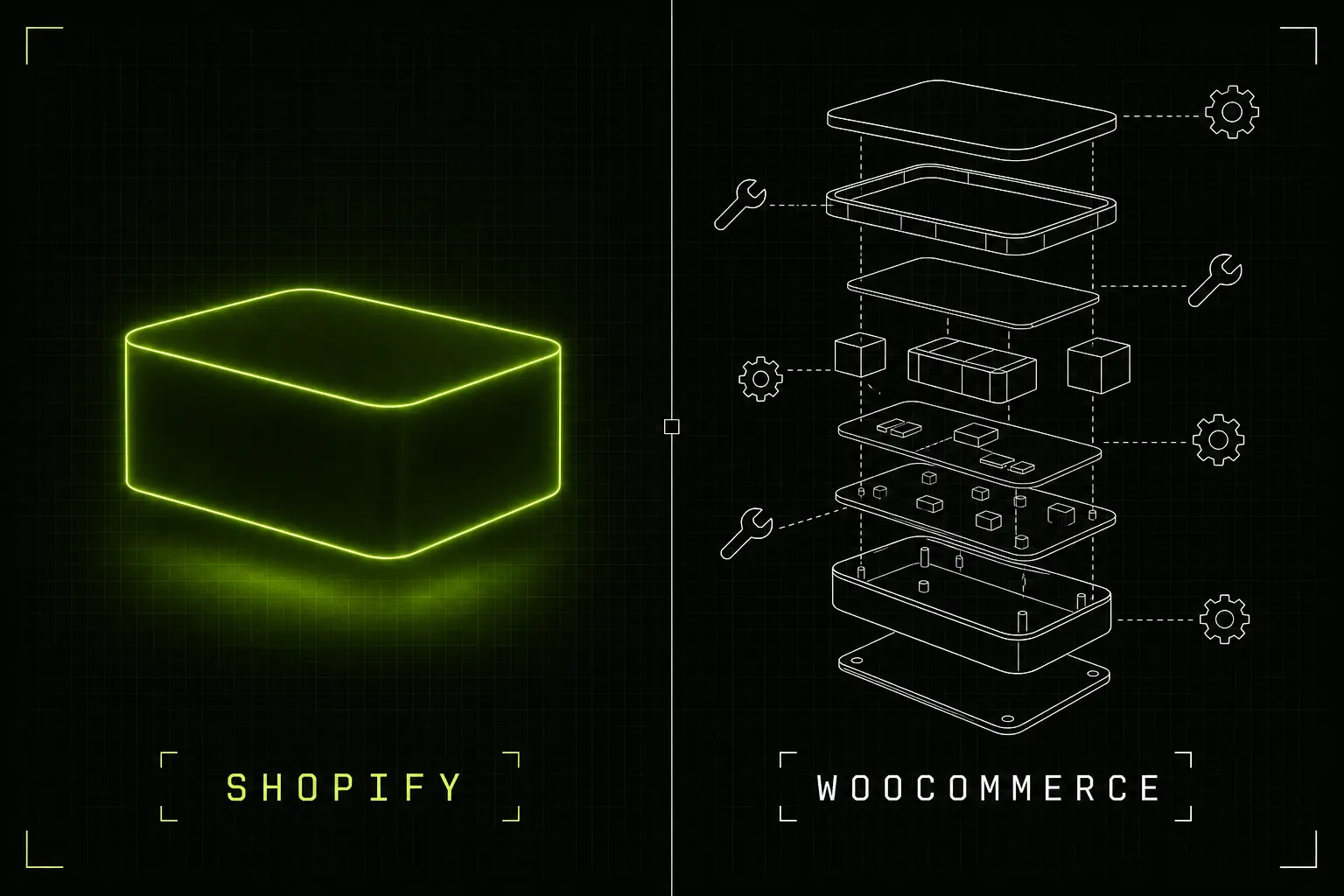
Shopify sells you a sealed, managed unit. WooCommerce hands you the parts and the responsibility.
Shopify vs WooCommerce at a glance
| Shopify | WooCommerce | |
|---|---|---|
| What it is | Hosted platform. You rent a complete, managed store. | Free WordPress plugin. You assemble and host the store yourself. |
| Monthly platform cost | £19 to £259 (billed annually), Plus from £1,800 | £0 licence, but £11 to £85 hosting |
| Who handles updates | Shopify. You never patch anything. | You. Core, extensions, themes and server. |
| Setup speed | Days. Sensible defaults out of the box. | Weeks. Every decision is yours to make. |
| Customisation ceiling | High, but within Shopify's rules. Checkout is locked below Plus. | Effectively unlimited. It is your code and your database. |
| Data ownership | Hosted by Shopify. Exportable, but not yours to move freely. | Entirely yours, on your own server. |
| Best suited to | Retailers who want to sell, not administer software. | Teams with technical resource, or unusual requirements. |
The real cost over three years
"WooCommerce is free" is technically true and practically misleading. The plugin costs nothing and takes 0% of your revenue. Everything required to actually run it costs money. Here is a realistic three-year comparison for a UK store of similar size on each platform, using published 2026 prices.
| Cost over 3 years | Shopify (Grow) | WooCommerce |
|---|---|---|
| Platform licence | £1,764 (£49/month, billed annually) | £0 |
| Hosting | Included | £400 to £3,000 |
| Apps and extensions | £1,080 to £5,400 | £450 to £1,650 |
| Security and performance tools | Included | Around £450 |
| Maintenance retainer | Not required | £5,400 to £14,400 |
| Total, self-managed | £2,850 to £7,150 | £1,750 to £5,100 |
| Total, agency-maintained | £2,850 to £7,150 | £7,150 to £19,500 |
Read the last two rows carefully, because they contain the whole argument. WooCommerce is cheaper when you supply the labour and more expensive when you buy it in.Shopify's price barely moves either way, because maintenance is not a line item you can be surprised by.
Two notes on the figures. UK hosting prices from providers like SiteGround and IONOS are quoted excluding VAT, so add 20% to compare fairly. And WooCommerce 10.8 and later requires WordPress 6.9+, PHP 8.3+ and 256MB of memory, which quietly rules out the £1.49 a month shared hosting deals that make WooCommerce look cheapest. Budget for hosting that can actually run it.
Transaction fees: where WooCommerce genuinely wins
This is the one dimension where WooCommerce has a clear, measurable advantage, and most comparisons get the numbers wrong.
| UK online card rate | Rate | Monthly platform fee | Fee for using another gateway |
|---|---|---|---|
| Shopify Basic | 2% + 25p | £19 | +2% |
| Shopify Grow | 1.7% + 25p | £49 | +1% |
| Shopify Advanced | 1.5% + 25p | £259 | +0.6% |
| WooCommerce (WooPayments) | 1.5% + £0.25 | £0 | None |
WooPayments matches Shopify's Advancedcard rate without the £259 a month that Advanced costs, and WooCommerce never penalises you for choosing your own gateway. If you have seen "1.4% + 20p" quoted for WooPayments elsewhere, that is the in-person card rate being misreported as the online one. The online rate is 1.5% + £0.25.
Before you conclude that fees settle it, run your own numbers. On £50,000 of monthly revenue at a £50 average order, Shopify Grow costs roughly £1,149 a month in plan and card fees against roughly £1,024 for WooCommerce with mid-tier hosting. WooCommerce saves about £125 a month, which is real, but less than the gap between maintaining the store yourself and paying an agency to.
One genuinely useful figure while you are here: moving from Shopify Grow to Advanced only pays for itself above roughly £105,000 in monthly revenue. Below that, the 0.2% saving does not cover the extra £210 a month in plan fees. Plenty of stores upgrade far too early.
What you are actually responsible for
Feature comparisons rarely mention this, and it is the difference most merchants feel day to day. On Shopify, updates, server security, uptime and platform patching are Shopify's problem. On self-hosted WooCommerce they are yours, which means someone must own:
- WordPress core and WooCommerce updates, which ship regularly. WooCommerce reached 10.9.4 in July 2026.
- Every extension and theme update, plus the conflicts they cause. A store running a dozen extensions will eventually hit one.
- Server patching and PHP version upgrades. Falling behind on PHP is both a security risk and, from 10.8 onwards, a compatibility one.
- Backups and recovery. If checkout breaks at 9pm on Black Friday, restoring it is on you.
- Performance. Cart and checkout pages cannot be cached, so cheap shared hosting struggles precisely when traffic spikes.
UK maintenance retainers for an ecommerce site typically run £150 to £400 a month, and specialist WooCommerce agencies quote considerably more. Worth noting that almost every published figure for this comes from firms who sell maintenance, so treat the higher end with appropriate scepticism. The point stands either way: the work exists, and someone is paying for it in money or hours.
When each one genuinely wins
Choose Shopify when:
- You want to launch quickly and sell, not administer software.
- Nobody on your team wants to own updates, hosting or security.
- You need reliable performance during traffic spikes without tuning for it.
- You sell across multiple channels and want that handled natively.
- You value a predictable monthly cost over a lower theoretical one.
Choose WooCommerce when:
- You already run WordPress and your content operation is the centre of the business.
- You need customisation Shopify will not permit, particularly around checkout.
- You have genuine technical resource in-house or a retained developer.
- Your requirements are unusual enough that no Shopify app fits.
- Owning your data and code outright is a strategic requirement.
A note on market share claims
You will see confident claims that one platform dominates. Treat them carefully: published figures put WooCommerce anywhere between 20% and 33% of ecommerce sites depending purely on who is counting. BuiltWith counts only sites actually processing orders, Store Leads casts a wider net, and W3Techs measures CMS usage. The directionally safe statement is that WooCommerce leads on raw install count while Shopify leads among higher-traffic, dedicated commerce stores. Neither fact should decide your platform.
Two 2026 changes worth knowing
If you are reading older comparisons, two things have moved. Shopify renamed its mid-tier plan from "Shopify" to "Grow" in April 2025, so any guide still referring to "the Shopify plan" predates that. And Automattic has discontinued Woo Express, its managed hosting offering, pointing merchants to WordPress.com Commerce or third-party hosts instead. That removes the one route that made WooCommerce feel as turnkey as Shopify.
So which should you choose?
For most UK retailers the honest answer is Shopify, because the thing that actually costs money is not the licence fee but the ongoing attention, and Shopify absorbs that. WooCommerce is the better choice when you have a specific reason to need it: a content-led business already on WordPress, a checkout requirement Shopify blocks, or in-house technical resource that makes the maintenance free to you.
What should not decide it is the sticker price. A store built on the wrong platform costs more to fix than either licence ever saves.
For build costs on each route, see our Shopify store cost guide, the ecommerce website cost guide with its three-year total, and the broader UK website cost guide. If you want a straight recommendation for your specific catalogue, that is what our ecommerce service starts with. Once the store is running, ecommerce automation covers the operational side, and website maintenance costs covers the monthly upkeep, which is where these two platforms differ most. If marketplaces are part of your mix as well, our marketplace seller support hub handles the account side of eBay, Amazon, Etsy, and Walmart, which is a different problem from picking a platform. Or browse every guide.
Frequently asked questions
Is WooCommerce really free?
The plugin is genuinely free and takes 0% of your revenue. Everything around it is not. You pay for hosting capable of running a shop, paid extensions for things Shopify includes as standard, security and caching tools, and either your own time or an agency retainer to keep it all patched. A realistically run WooCommerce store costs £1,750 to £5,100 over three years if you maintain it yourself, and £7,150 to £19,500 if you pay someone else to.
Which is cheaper for a UK store, Shopify or WooCommerce?
WooCommerce is cheaper if your own time is free and you are comfortable maintaining a WordPress stack. Shopify is usually cheaper once you price maintenance honestly, because updates, security patching and plugin conflicts are Shopify's problem rather than yours. The crossover is about labour, not licence fees.
What are WooCommerce transaction fees in the UK?
WooCommerce itself charges no transaction fee. If you use WooPayments, UK online card payments cost 1.50% + £0.25 per transaction, with an extra 2% on international cards and a £15 dispute fee. That matches Shopify's Advanced plan rate without the £259 a month plan fee, which is WooCommerce's strongest financial argument.
Does Shopify charge extra if I do not use Shopify Payments?
Yes, and it is the fee most merchants miss. Using an outside gateway such as PayPal or Stripe as your main processor adds a Shopify fee on top of whatever your processor charges: 2% on Basic, 1% on Grow, 0.6% on Advanced and 0.2% on Plus. WooCommerce applies no equivalent charge whichever gateway you choose.
Do I need a developer to run WooCommerce?
Not to launch, but realistically yes to run it well. WooCommerce 10.8 and later requires WordPress 6.9+, PHP 8.3+ and 256MB of memory, which rules out the cheapest shared hosting. Someone has to own core updates, extension updates, plugin conflicts and backups. UK maintenance retainers for a store typically run £150 to £400 a month.
Which is better for SEO?
Both can rank well and neither has a decisive structural advantage. WooCommerce gives you deeper technical control through plugins like Yoast or RankMath and full URL control. Shopify is faster out of the box and needs less tuning, but imposes some URL structures you cannot change. Content quality and site speed decide this far more than the platform does.