How much does website maintenance cost?
Website maintenance is the easiest thing in this industry to overcharge for, because the work is invisible and the risk of skipping it is deferred. Here are the real UK monthly bands, what a care plan should say in writing, and the cases where the honest answer is that you do not need one.
Quick answer: most UK small business sites pay £30 to £150 a month. A basic care plan is £30 to £80, a plan with real support and content changes is £80 to £250, and ecommerce or business-critical sites run £250 to £600+. The single biggest variable is not your business, it is your platform: WordPress typically costs two to four times more to maintain than an equivalent site on Webflow, Shopify or Squarespace, because there is genuinely more to do.
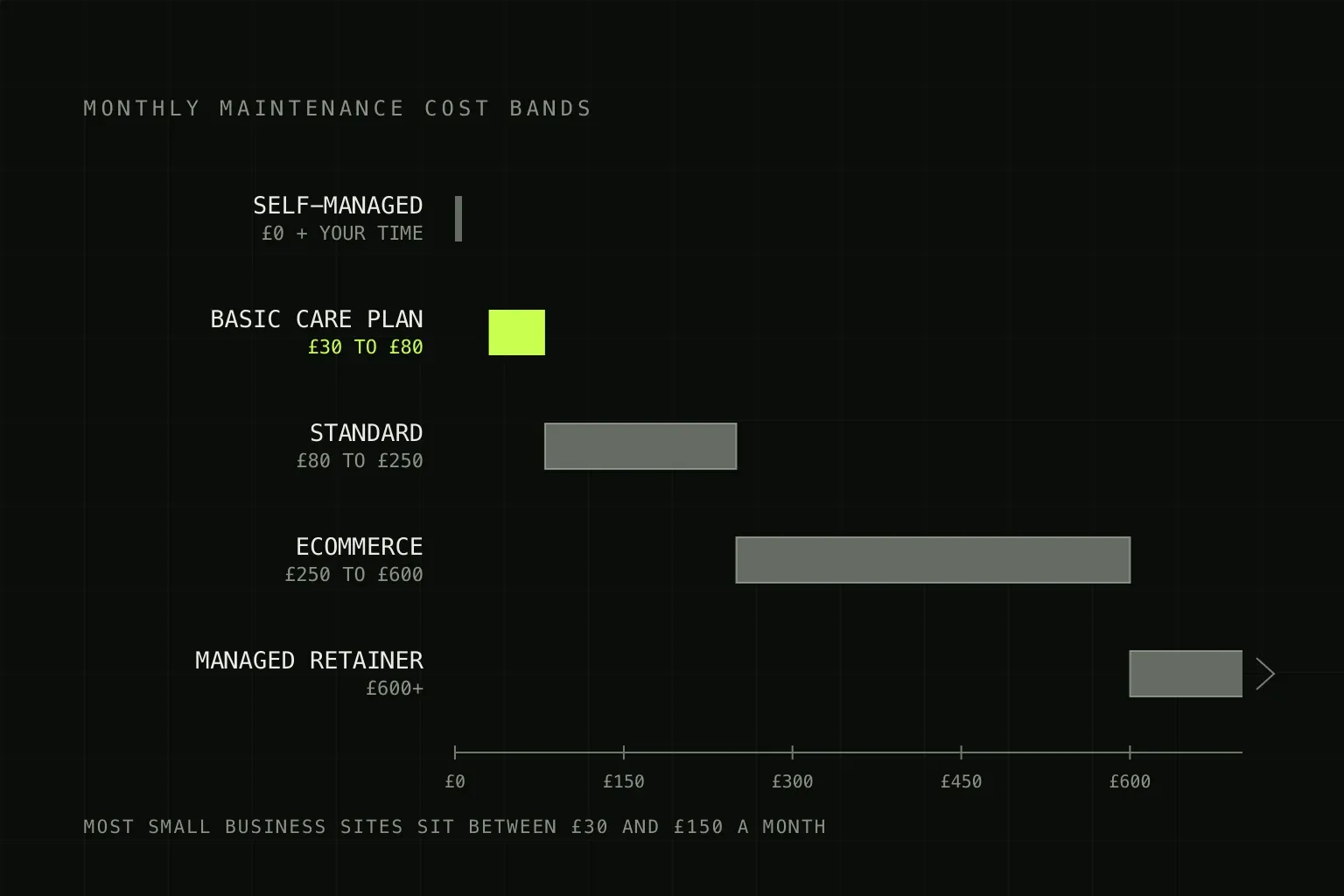
Most small business sites sit in the first two paid bands.
What website maintenance actually is
"Maintenance" gets used for two different things, and conflating them is how quotes become impossible to compare. There is keeping the site working, and there is changing the site. Only the first is maintenance.
- Platform and plugin updates. Applying them, ideally on a staging copy first, and checking nothing broke afterwards. Almost entirely a WordPress concern.
- Backups. Taken off-site, on a schedule, and restorable. A backup nobody has ever restored is a theory, not a backup.
- Uptime monitoring. Something checks the site every few minutes and tells a human when it stops responding. This should cost almost nothing.
- Security. Malware scanning, login hardening, and keeping on top of disclosed vulnerabilities in whatever the site runs on.
- Health checks. Do the forms still send. Are there broken links. Has a page started 404ing. Has page speed degraded since someone uploaded a 6MB image.
- Small content edits. Usually an allowance of an hour or two a month. This is the part clients actually value, and the part most likely to be quietly capped.
New pages, design changes, new features, SEO campaigns and copywriting are not maintenance. They may well be worth buying, but they belong in a separate line on the invoice so you can judge each on its own merits.
UK website maintenance prices by tier
| Tier | UK monthly price | What it typically covers |
|---|---|---|
| Self-managed, hosted platform | £0 plus the subscription | You edit your own content and the platform handles everything underneath. Entirely legitimate for a small brochure site on Squarespace, Webflow or Shopify. |
| Basic care plan | £30 to £80 | Updates, backups, uptime and security monitoring, and a monthly report. Little or no included support time. Mostly automated on the provider's side, which is why it is cheap. |
| Standard small business plan | £80 to £250 | The above plus one to three hours of changes a month, a named contact, and a stated response time. This is the band most UK small businesses land in. |
| Ecommerce or business-critical | £250 to £600 | Staging environment, tested deployments, checkout and payment monitoring, faster response commitments, and someone reachable when it breaks on a Saturday. |
| Managed retainer with strategy | £600 upward | Maintenance folded into an ongoing development and optimisation relationship. At this point you are buying capacity, not maintenance, and should judge it as such. |
These are the bands we see quoted across the UK market. They are informed ranges rather than a survey. The build cost that precedes all of this is in the UK website cost guide.
Why WordPress costs more to maintain
This is the single biggest driver of your monthly number, and it is worth understanding before you either overpay or under-protect.
WordPress is software you host. That means you own the stack: the WordPress core, the theme, every plugin, the PHP version, and the server. A typical small business WordPress site runs somewhere between fifteen and thirty plugins, each written by a different third party, each updating on its own schedule, each capable of conflicting with another. That surface area is the cost.
Webflow, Shopify, Squarespace and Wix are hosted platforms. The company maintains the platform as part of what you already pay them. There is no core to update, no plugin conflict to resolve, no PHP version to worry about. What remains is content, monitoring, and the occasional check that your forms still work.
The practical consequence: a mandatory £150 a month "maintenance and updates" retainer on a Squarespace site should prompt a direct question about what is being updated. On a WordPress site the same number is often entirely fair. The Webflow vs WordPress comparison works through the three-year cost of ownership including this, and Shopify vs WooCommerce does the same for stores, where the gap is wider still.
What a care plan should say in writing
Most maintenance disputes are not about price. They are about whether a particular request was "included". Get these six things stated explicitly and that argument never happens.
- How much change time is included, and what counts as a change. Swapping a phone number is not the same as adding a page. Both need to be on one side of the line or the other.
- Do unused hours roll over? Usually no, which is fine if you know it. Not knowing it is what makes people feel cheated in a quiet month.
- Response time, and what counts as an emergency. "We aim to respond quickly" commits to nothing. "One working day, or four hours if the site is down" commits to something.
- Where the backups live and how you get them. You should be able to obtain a full backup on request without a discussion. If backups only exist inside your provider's system, you have a dependency rather than a safety net.
- What the monthly report contains. Uptime, updates applied, backups taken, anything that needed fixing. A report saying "maintenance completed" is not a report.
- Notice period, and what happens on cancellation. You should leave with the site, the domain, the hosting access and the backups. This should be a one-word answer.
What actually goes wrong when nobody maintains it
The honest version, because scaring people into retainers is a well-worn sales tactic and most of the scare stories are about WordPress specifically.
On a hosted platform, typically very little happens for a long time. The site keeps serving. The most likely failures are your own: a contact form pointing at an inbox nobody checks any more, an expired domain because the renewal email went to a former employee, or content that quietly stopped being true two years ago. None of these are fixed by a technical retainer, which is worth noticing.
On WordPress, the failure modes are specific:
- An abandoned plugin. The developer stops maintaining it, a vulnerability is disclosed, and there is no patch coming. Nothing visible changes until it is exploited.
- An auto-update conflict. Two plugins disagree after one updates, and a page or a form breaks. Often on a page you rarely look at, which is why it can sit broken for months.
- PHP end of life. Your host eventually forces a PHP upgrade. If the site has not been kept current, that upgrade is the moment it breaks, and it will not be a convenient moment.
- Spam injection. An outdated form or comment plugin gets used to relay spam. The first symptom is usually a deliverability problem with your own email, or a Google Search Console warning.
The pattern to notice is that none of these announce themselves. That is the actual argument for a retainer on WordPress: not that disaster is likely this month, but that you will not be the one who notices.
The honest test: do you need a plan?
Three questions. If you answer no to all three, you probably do not need to be paying anyone monthly.
- Is the site on WordPress or another self-hosted platform? If yes, you need someone doing updates, whether that is a provider or a disciplined person on your team.
- Does the site take money or bookings? If yes, downtime has a direct cost and the monitoring is worth paying for on its own.
- Would you actually notice if it broke? Be honest. If you last looked at your own site in March, the answer is no, and monitoring is cheap insurance against a silent outage.
A no to all three, on a hosted platform, with a site you look at regularly, means the sensible spend is nothing. Put a free uptime monitor on it and check the contact form once a quarter.
Red flags in a maintenance quote
- A mandatory retainer on a hosted-platform site, sold as "updates and security". Ask what is being updated. If the answer is vague, the platform is already doing it.
- "SEO included" with no stated deliverable. Real SEO has outputs you can see. Bundled unspecified SEO is usually padding. What SEO actually costs covers what a genuine service looks like.
- You cannot get a backup without asking permission. A dependency dressed as a service.
- Cancelling means losing the site. This is a rental, not a maintenance plan. It should be stated on the front of the contract, and it usually is not.
- No monthly report. If nothing is reported, nothing is verifiable, and you are paying for a promise.
- Hourly billing for updates on a small site. The work is predictable and repetitive, so the price should be too.
Where we sit
We build on hosted platforms wherever the project allows, specifically so this number stays small. A site that does not need much maintenance is a better outcome than a site with a good maintenance plan, and it costs you less every month for as long as you own it.
When a project genuinely needs WordPress or custom code, we say so and we are direct about what the ongoing commitment looks like before you commit to the build, rather than after. If you have an existing site and an existing retainer and you are not sure it is fair, send us the invoice and the site and we will tell you what we think, including when the answer is that it looks reasonable.
Related reading: why is my website slow if performance is the thing you are hoping a care plan will fix, what a redesign costs if the site has reached the point where maintaining it is no longer the question, which platform to use if you are choosing now and want to keep the running cost down, and Glasgow web design prices for local build costs.
Frequently asked questions
How much does website maintenance cost per month in the UK?
Most UK small business sites sit between £30 and £150 a month. A basic care plan covering updates, backups and uptime monitoring typically runs £30 to £80. A plan that also includes real support and a monthly allowance of content changes runs £80 to £250. Ecommerce and business-critical sites run £250 to £600 or more, because downtime costs money and the testing burden is higher. Self-managing a site on a hosted platform can genuinely cost £0 beyond the subscription.
Do I need a website maintenance plan?
It depends far more on your platform than on your business. A WordPress site with a stack of plugins genuinely needs someone applying updates and checking nothing broke, because that risk is real and cumulative. A site on Webflow, Shopify or Squarespace is maintained by the platform itself, so a mandatory monthly retainer for updates is largely selling you something the platform already does. The honest test is whether you can name what the retainer does each month.
What is included in website maintenance?
A reasonable plan covers platform and plugin updates, off-site backups you can actually access, uptime monitoring, security scanning, broken link and form checks, and a small allowance of content edits. Things frequently excluded and frequently assumed: new pages, design changes, SEO work, copywriting, and anything that counts as a new feature. Ask for the split in writing before you sign, because that ambiguity is where most maintenance disputes start.
Is WordPress more expensive to maintain than Webflow or Shopify?
Yes, and structurally rather than accidentally. WordPress is software you host, so you own the core updates, the PHP version, the hosting, and every plugin in the stack. Each plugin is third-party code that can break, get abandoned, or introduce a vulnerability. Webflow, Shopify and Squarespace maintain the platform themselves as part of the subscription, so there is far less to pay anyone to do. Budget roughly two to four times more for WordPress maintenance than for a comparable hosted site.
What happens if I do not maintain my website?
On a hosted platform, usually nothing for a long time, because the platform handles the underlying updates. On WordPress the failure modes are specific and real: an abandoned plugin stops receiving security patches, an auto-update introduces a conflict that breaks a page nobody visits often, the PHP version reaches end of life and the host forces an upgrade the site is not ready for, or an outdated form plugin becomes a spam relay. None of these announce themselves. You find out when a customer tells you.
Can I do website maintenance myself?
For a hosted-platform site, largely yes. Check the contact form works, keep an eye on the analytics, and review the content every quarter. For WordPress it is possible but the discipline is the hard part: updates need applying regularly, on a staging copy where possible, with a backup you have tested restoring. Most small businesses can do this and simply do not, which is what the retainer is really buying.