Web design for charities
Most charity briefs read like business briefs with a donate button added. That is the expensive mistake. A charity website carries four obligations a commercial site does not, three of them set by someone outside your organisation, and every one of them is cheaper to build in than to retrofit.
Quick answer: four things. Accessibility is a legal duty under the Equality Act 2010, benchmarked at WCAG 2.2 AA. The Google Ad Grant is worth $10,000 a month in search ads and your website is the eligibility gate. The Gift Aid declaration adds 25p to every pound, and it has to be captured in the donation flow. And trustees sign off, not a marketing manager, which changes both the timeline and who needs to be able to edit the thing afterwards.
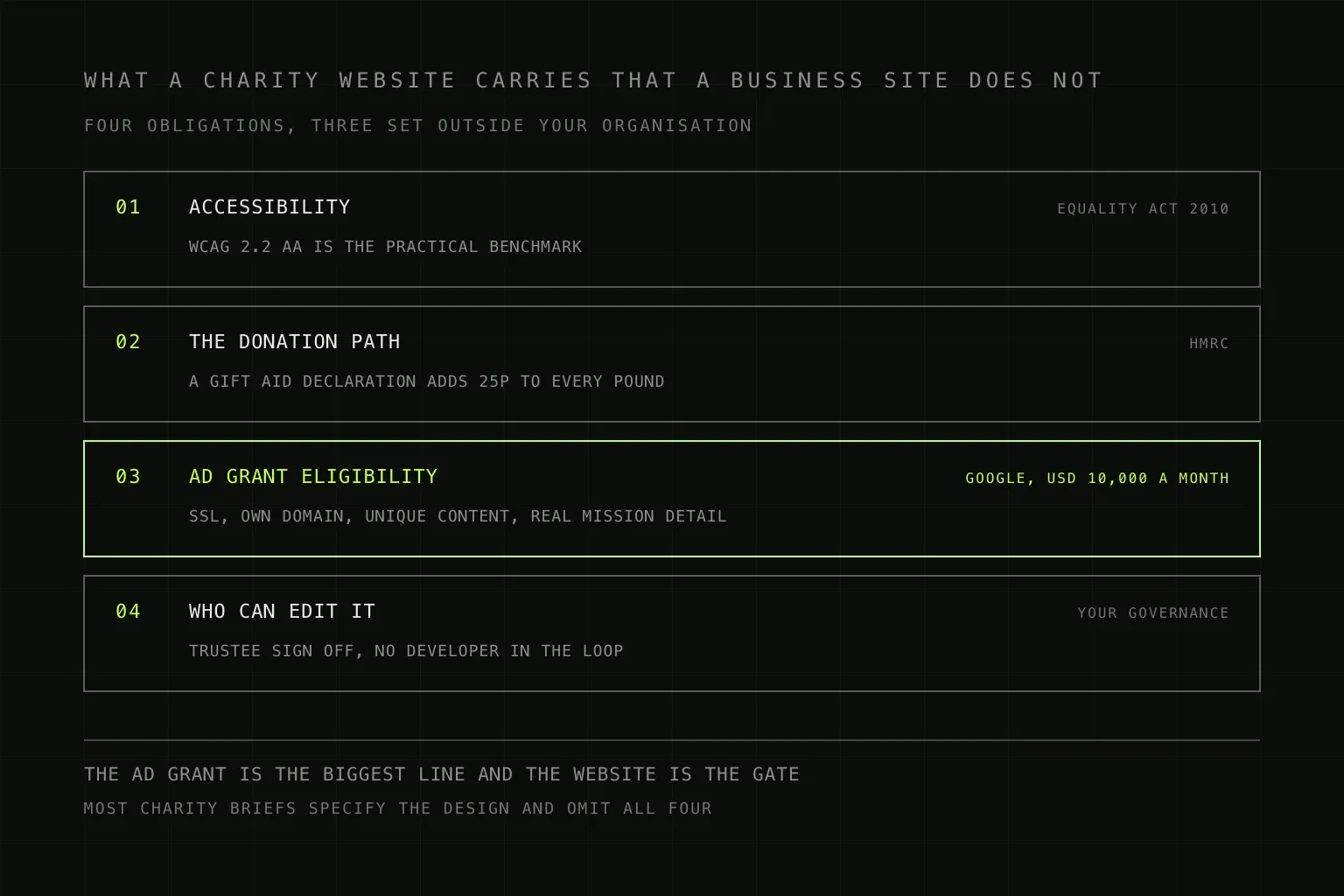
Three of the four are set outside your organisation. Most briefs specify none of them.
1. Accessibility is a duty, not a feature
This is the one that gets quoted as an optional extra and should not be. The Equality Act 2010 treats anyone providing a service to the public as a service provider and requires reasonable adjustments so disabled people can use that service on an equal basis. Websites have consistently been read as within scope. Crucially the duty is anticipatory: you are expected to remove barriers in advance rather than react once someone tells you they cannot donate.
There is a second, stricter regime worth knowing about. The Public Sector Bodies (Websites and Mobile Applications) Accessibility Regulations 2018 apply explicitly to public sector bodies, and they reach charities that deliver public sector functions or are financed mainly by public money. If a meaningful share of your income is local authority or NHS contracts, do not assume you are outside it. Check, because that regime brings an explicit standard and a published accessibility statement with it.
For a build, both roads lead to the same working target: WCAG 2.2 Level AA. In practice that means real text contrast rather than pale grey on white, keyboard operability throughout including the donation form, visible focus states, labelled form fields, alt text that says something, and headings used as structure rather than as font sizes.
The retrofit trap: accessibility is close to free when it shapes the design and expensive when it arrives afterwards. Fixing contrast means revisiting the palette, which means revisiting the brand. Fixing keyboard traps in a donation flow means rebuilding the donation flow. Get it into the brief and it costs you almost nothing. Get it in a remediation report and it costs you a project.
2. The Ad Grant is the biggest number in the room
Google Ad Grants gives eligible charities $10,000 a month in Google Search advertising. For most small and mid-sized UK charities that is larger than the entire digital budget, and it is gated on the website. This is the single strongest commercial argument for doing the site properly, and it is missing from almost every charity brief we see.
Eligibility has three parts. You need current valid charity status. You need to accept the Google for Nonprofits terms. And your site has to pass their website policy: you own the domain, the content is unique rather than copied, there is genuine detail about your mission and activities, and you have a valid SSL certificate so the browser shows a lock rather than "not secure".
Some categories are excluded whatever their charitable status: government entities, hospitals and healthcare organisations, and schools, academic institutions and universities. The exclusion runs on what the organisation is, so a registered charity whose main activity is running a school is generally outside the programme.
Keeping the grant is a separate discipline from getting it, and this is where charities lose it:
| Rule | Requirement | What it means for the website |
|---|---|---|
| Click-through rate | At least 5%, sustained | You need specific pages answering specific queries. Pointing every ad at the homepage is the usual cause of failure. |
| Keyword quality | Minimum quality score, anything at 1 or 2 paused | Quality score is partly landing page relevance, so it is a website problem as much as an ads problem. |
| Keyword shape | No single-word keywords outside a short approved list | Content has to target phrases people actually type, not one-word topics. |
| Bidding | $2 maximum cost-per-click on standard bidding | Caps how competitive a term you can chase, which pushes you towards long-tail pages. |
Google revises these periodically, so treat the current Ad Grants policy documentation as the authority rather than any article, including this one. The structural point holds regardless: the grant rewards sites with many specific, genuinely useful pages and punishes brochure sites with five pages and a donate button. If you are building anyway, build for that.
3. The donation path, and the 25p you are leaving behind
Gift Aid lets a charity reclaim 25p for every £1 donated by a UK taxpayer. That is a 25% uplift on eligible donations for no additional fundraising, and it is entirely conditional on capturing a valid Gift Aid declaration from the donor, who must have paid enough Income Tax or Capital Gains Tax that year to cover the claim.
The declaration is a design problem. It has to sit inside the donation flow at a point where the donor will actually complete it, worded so the tax condition is clear, and the record has to reach whatever system you claim from. A declaration bolted on as a follow-up email converts far worse than one in the flow, and every missed declaration is 25% of that donation gone.
Two more things about the donation path that briefs routinely omit. First, the donation platform is usually the real platform constraint on the whole project, more than any design preference, because that integration is the one you genuinely cannot compromise. Establish it before you shortlist anything. Second, platform fees are separate from the build and are an ongoing percentage, so compare them the way you would compare payment processing on an ecommerce project rather than treating them as a footnote.
4. Trustees sign off, and that changes the build
On a commercial project one person usually owns the decision. On a charity project the decision belongs to a board that may meet quarterly. This is not a problem to be solved, it is a constraint to be designed around, and ignoring it is why charity web projects overrun.
Two practical consequences. Get sign-off points scheduled against actual board dates before the project starts, rather than discovering in week three that the next meeting is in six weeks. And build for editing without a developer, because the gap between what a charity can change itself and what it has to pay for is the difference between a site that stays current and one that is visibly three years old.
Ownership matters more here than in commercial work too. The domain, the hosting account and the CMS workspace should be in the charity's name from day one, not the agency's. Staff and trustees turn over, and a site nobody can access is a genuine governance problem rather than an inconvenience. The wider version of this question is in which website platform should you use.
What the law actually says about your charity number
Worth getting precise, because this is repeated loosely everywhere. Section 39 of the Charities Act 2011 requires a registered charity in England and Wales whose gross income in its last financial year exceeded £10,000 to state, in legible characters, that it is a registered charity. The statute lists the documents: notices, advertisements and other documents issued by or on behalf of the charity and soliciting money or other property, plus bills of exchange, promissory notes, cheques and orders for money, and bills, invoices, receipts and letters of credit.
The Act does not name websites. That is a genuine gap rather than a trick, because it was drafted around paper. The practical reading is that a donation page is unambiguously a document soliciting money, so the statement belongs there. Trying to reason page by page about which parts of a site solicit money is a poor use of anyone's time, so put the registered charity statement and number in the site footer and stop thinking about it. Scotland and Northern Ireland have their own regulators and their own rules, so if you are registered with OSCR or CCNI check those rather than assuming section 39 covers you.
What this costs
The same variables drive a charity build as any other: template count, content volume, integration surface, and who writes the copy and supplies the photography. The full market picture for UK sites is in our website cost guide and the numbers there apply here too.
The charity-specific additions worth costing explicitly, because they are the ones that turn up as change requests:
- The donation flow and its integration. Not a form. A flow with amount selection, the Gift Aid declaration, the platform integration and the thank-you path that follows.
- Accessibility work on existing content. A new build can be accessible from the start. Two hundred inherited pages with unlabelled images and poor contrast is a separate, sizeable job, and it should be quoted separately rather than assumed.
- Content pages for the Ad Grant. If you intend to use the grant, the pages that make it work are part of the project, not a later phase.
- A longer approval cycle. Board dates are real calendar time and belong in the plan.
One thing not to pay for: an accessibility overlay widget. They are sold hard to charities specifically, they do not deliver WCAG conformance, and they are the reason a number of organisations believe they are compliant when they are not. Fix the site.
Where we sit
We build on whichever platform the answers point to rather than a house favourite, which matters more than usual here because the donation platform frequently decides it. Fixed-price projects start from £2,500 and ship in two to four weeks, with a written quote before anything begins and the scope stated rather than implied. Pricing and scope are on the web design service page.
If you are at the brief stage, the useful thing is not a quote. Tell us your income band, your donation platform, whether you hold any public sector contracts, and when your board next meets, and you will get a straight answer on which of the four obligations above actually bind you and what they add. That is a short conversation and it regularly changes what people were about to buy. Send us the brief.
Frequently asked questions
Do UK charities legally have to have an accessible website?
In practice yes, though the route differs. The Equality Act 2010 treats anyone providing a service to the public as a service provider, and requires reasonable adjustments so disabled people can use that service. Regulators and courts have consistently read websites as within scope, and the duty is anticipatory: you are expected to remove barriers rather than wait for a complaint. Separately, the Public Sector Bodies (Websites and Mobile Applications) Accessibility Regulations 2018 impose a harder, explicit standard, and they catch charities that deliver public sector functions or are financed mostly by public money. If you hold local authority or NHS contracts, assume the stricter regime applies and check. Either way the working benchmark is the same: WCAG 2.2 Level AA.
Is my charity eligible for the Google Ad Grant?
You need current valid charity status in your country, you must agree to the Google for Nonprofits terms, and your website has to pass their website policy. Some categories are excluded outright regardless of charitable status: government entities, hospitals and healthcare organisations, and schools, academic institutions and universities. Note the exclusion is by organisation type, so a charity whose primary activity is running a school is generally out even though it is a registered charity.
Why did my charity lose its Google Ad Grant?
Almost always ongoing account policy rather than eligibility. The account has to hold a click-through rate of at least 5%, keywords must clear a minimum quality score with anything scoring 1 or 2 paused, single-word keywords are not allowed outside a short approved list, and there is a $2 maximum cost-per-click on standard bidding. Accounts also get suspended for sitting unmanaged. The CTR rule is the one that catches people, because it pushes you towards specific pages matching specific queries rather than pointing every ad at your homepage. Google revises these, so check the current Ad Grants policy page before you rebuild anything around them.
Do I have to display my charity number on my website?
Section 39 of the Charities Act 2011 requires a registered charity in England and Wales with gross income above £10,000 in its last financial year to state that it is a registered charity, in legible characters, on a defined list of documents. That list covers notices, advertisements and other documents soliciting money or property, plus bills of exchange, cheques, invoices, receipts and letters of credit. The statute does not name websites. In practice a donation page is a document soliciting money, so put the statement there, and the sensible move is a footer line across the whole site rather than trying to reason about which pages count.
How much does a charity website cost in the UK?
The same things drive it as any other build: how many templates, how much content, how many integrations, and who writes the copy. The charity-specific additions are the donation flow, the Gift Aid declaration, accessibility testing against WCAG 2.2 AA, and usually a longer approval cycle because trustees sign off rather than one marketing lead. Our market range for UK websites generally is in the website cost guide. The two charity line items most often missed at quoting stage are accessibility remediation on existing content and the donation platform's own fees, which are separate from the build.
What is the best platform for a charity website?
There is no category answer, and anyone who gives you one before asking about your integrations is guessing. Decide it on four things: who edits the site and how often, whether your content is bespoke pages or repeating records, what the site has to talk to (your CRM, your donation platform, your event system), and who owns the account in three years. The donation platform is usually the constraint that decides it, because that integration is the one thing you cannot compromise on. Answer those first and the shortlist collapses to one or two.
Related guides: the platform decision in full is in which website platform should you use, and the budget picture in how much a website costs in the UK. If you have an existing site that is not bringing people in, start with why is my website not ranking, and if they arrive but do not donate, why is my website not converting works through the causes in order. For choosing who builds it, how to choose a web design agency.