Why is my website not converting?
The instinct is to redesign. It is almost always the wrong first move, because a redesign changes fifty things simultaneously and teaches you nothing. There are four common causes, they need checking in a particular order, and three of them are cheaper than a redesign.
Quick answer: check in this order. One, is the traffic commercial, or are you ranking for questions rather than purchases. Two, does the landing page answer the exact thing that was searched. Three, can a stranger find a price, some proof and an obvious next step in fifteen seconds. Four, is the form or checkout asking for more than it needs. Only redesign once you know which of those it is.
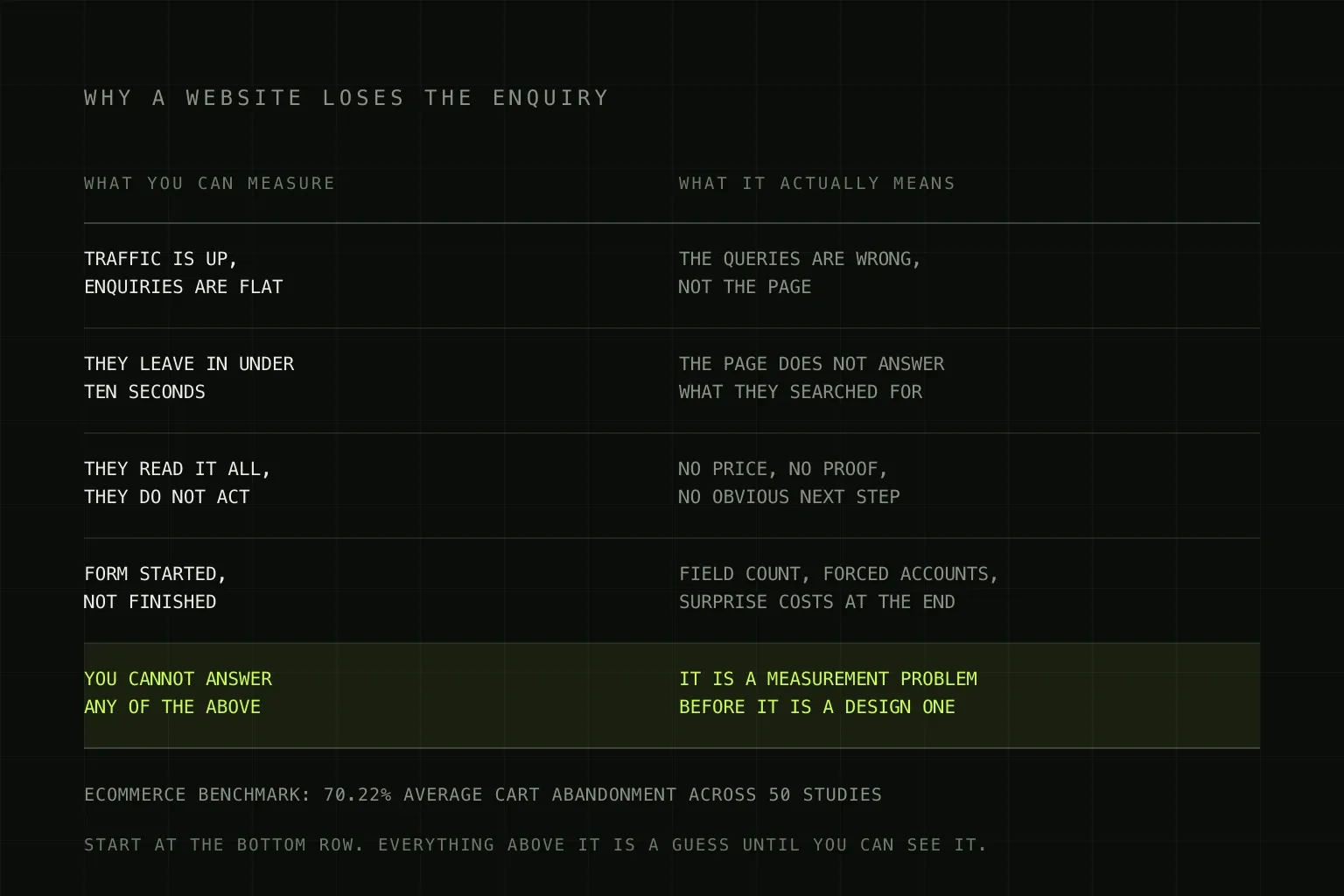
Each symptom points at a different fix. The bottom row is where most sites actually are.
Start at the bottom row: can you see anything at all?
The uncomfortable first question is not about the design. It is whether you can answer, with data rather than impression, how many people arrived last month, what they searched, which page they landed on, and how many of them started your form. On a surprising number of sites the honest answer is no, because the form submits to an inbox with no event tracked, and traffic is judged by feel.
If that is you, fix that first. It is a few hours of work and it costs almost nothing, and without it every conversation about conversion is two people guessing. You need three things: analytics that records a conversion event when the form actually submits, Search Console connected so you can see what queries brought people, and a note of what a lead is worth to you. That last one is not a technical task and it is the one people skip.
Cause 1: the traffic is not commercial
This is the most common and the least suspected, because the traffic graph looks healthy. A site that ranks well for "how much does X cost" and "what is X" is collecting researchers. Some of them buy eventually. Most were never going to.
Open Search Console, look at your top queries by impressions, and sort them into two piles: people trying to understand something, and people trying to buy something. If the second pile is thin, the site is converting the traffic it has at a perfectly normal rate, and the problem is upstream. You need pages that target purchase-intent queries, which are lower volume and higher value, rather than better buttons on the pages you have.
The signal that confirms it: your conversion rate is fine when you segment by branded and direct traffic, and terrible on organic. That is a traffic-mix problem wearing a conversion problem's clothes.
Cause 2: the page does not answer what was searched
Someone searches a specific question, lands on a general page, and leaves in under ten seconds. The page is not bad. It is just not about the thing they typed.
This is the single most common gap between SEO and design working separately. The page ranks, so SEO calls it a win. The page looks good, so design calls it a win. The visitor arrives, does not see their question reflected in the first screen, and goes back to the results. Check it directly: take your top five landing pages from Search Console, look at the top query for each, and ask whether the first paragraph of that page answers it. Often it opens with a paragraph about the company instead.
Cause 3: no price, no proof, no next step
The visitor read the whole page and did nothing. That is a different failure to leaving immediately, and it means the page held their attention but did not give them enough to act on. Three things are usually missing.
| Missing | What the visitor does | Cheapest fix |
|---|---|---|
| Price signal | Assumes it is out of reach, or that asking means a sales process | Publish a starting price or a range, even if the exact figure depends on scope |
| Proof | Has no reason to believe the claims, because every competitor makes them too | Named work, named clients, real numbers. Anonymous testimonials read as invented |
| An obvious next step | Reaches the end of the page and finds nothing to do | One clear action per page, repeated where the reader is likely to be ready |
Pricing is the one people argue about. The concern is that publishing figures scares people off, and it does, specifically the people who were not going to buy. What it also does is stop the ones who could afford you from assuming they could not. If the exact figure genuinely depends on scope, a starting point does most of the work.
Cause 4: the form or checkout is doing the damage
The visitor decided to act and then stopped part way. This is the only cause where you can see the exact drop-off, and it is usually the cheapest to fix.
For ecommerce there is real data here. Baymard Institute puts documented average cart abandonment at 70.22% across 50 studies. Most of that is browsing and always will be. But among people who reach the checkout and then leave, the stated reasons cluster tightly: unexpected extra costs at the end, delivery too slow, not trusting the site with card details, being forced to create an account, and a checkout that takes too long. Four of those five are decisions someone made deliberately, and all five can be changed without redesigning anything.
For service businesses the equivalent is the enquiry form. Count the fields. If it asks for company size, budget range, how you heard about us, and a dropdown of eleven services, it is optimised for the recipient's convenience and against the sender's. Name, contact and a sentence gets more real conversations than a qualified form gets qualified ones.
What about speed?
Speed shows up as a conversion problem when it is bad enough that people leave before the page draws, which is a real thing and worth ruling out early because it is cheap to check. It stops being the explanation once the page is loading in a couple of seconds. If your Largest Contentful Paint is over four seconds you have a genuine leak, and why is my website slow covers how to find where the time goes. Below that threshold, look at the four causes above before you spend anything more on performance.
The order matters
Going straight to cause 3 or 4 is tempting because those are the visible ones, and it is how most conversion projects get sold. But fixing a form on a page that the wrong people are landing on improves nothing, and you will conclude that conversion work does not do anything. Work down the list. Each step either rules something out or hands you the answer, and by the time you reach a redesign you will know exactly what it needs to change.
Where we sit
We would rather do the diagnosis than sell the redesign. A fair share of the sites we are asked to rebuild do not need rebuilding, and saying so has cost us projects and won us better ones. When a rebuild genuinely is the answer, fixed-price projects start from £2,500 and ship in two to four weeks, with the conversion path designed before the visuals rather than after.
If you want a straight read on which of the four causes you have, send the URL and what you sell. Scope and pricing on the web design service page. If the underlying issue is that too few people arrive in the first place, why is my website not ranking is the right guide instead.
Frequently asked questions
What is a good conversion rate for a website?
There is no honest single number, and the ones quoted in blog posts are usually averages across wildly different businesses. A £30 impulse product and a £30,000 consultancy engagement should never be held to the same rate. The useful comparison is your own site last quarter, and your own cost per enquiry against what an enquiry is worth to you. If someone opens with an industry benchmark rather than a question about your numbers, be careful.
Should I redesign my website to improve conversions?
Not as the first move. A redesign changes everything at once, which means if the number moves you will not know what moved it, and if it drops you cannot undo the part that hurt. Diagnose first. In practice the fixes that matter most are usually specific rather than wholesale: a page that does not answer the query it ranks for, a missing price, no proof, or a form asking for eleven things when it needs four.
Why is my traffic going up but enquiries staying flat?
Almost always because the new traffic is a different kind of person. Rankings gained on informational queries bring readers, not buyers. Check the Search Console queries driving the growth. If they are questions rather than purchase intent, the site is working correctly and the traffic is simply not commercial. That is a content strategy issue, not a design one.
Does putting prices on my website lose me leads?
It loses you enquiries, which is not the same thing. It removes people who were never going to buy at your level, and it raises the quality of the ones who do get in touch. If you have a real reason not to publish exact figures, publish a starting point or a range instead. A page with no pricing signal at all forces the visitor to guess, and people who guess usually guess that it is too expensive and leave.
How many form fields is too many?
Ask for the minimum you need to have a useful first conversation, which for most service businesses is name, contact and a sentence about the job. Every additional field is a small tax on a person who has not decided to trust you yet. Anything you can look up yourself or ask later should not be on the form.
What is the average cart abandonment rate?
Baymard Institute puts the documented average at 70.22%, drawn from 50 separate studies. Two things follow. Most of that is browsing behaviour and will never convert regardless of what you do. But the reasons people give for abandoning at the checkout itself are largely fixable: unexpected extra costs, delivery that is too slow, not trusting the site with card details, being forced to create an account, and a checkout that takes too long.
Related guides: website redesign costs covers what a rebuild runs to once you have decided you need one, ecommerce website costs covers building the store side, and how to choose a web design agency covers spotting the ones who diagnose before they quote.